
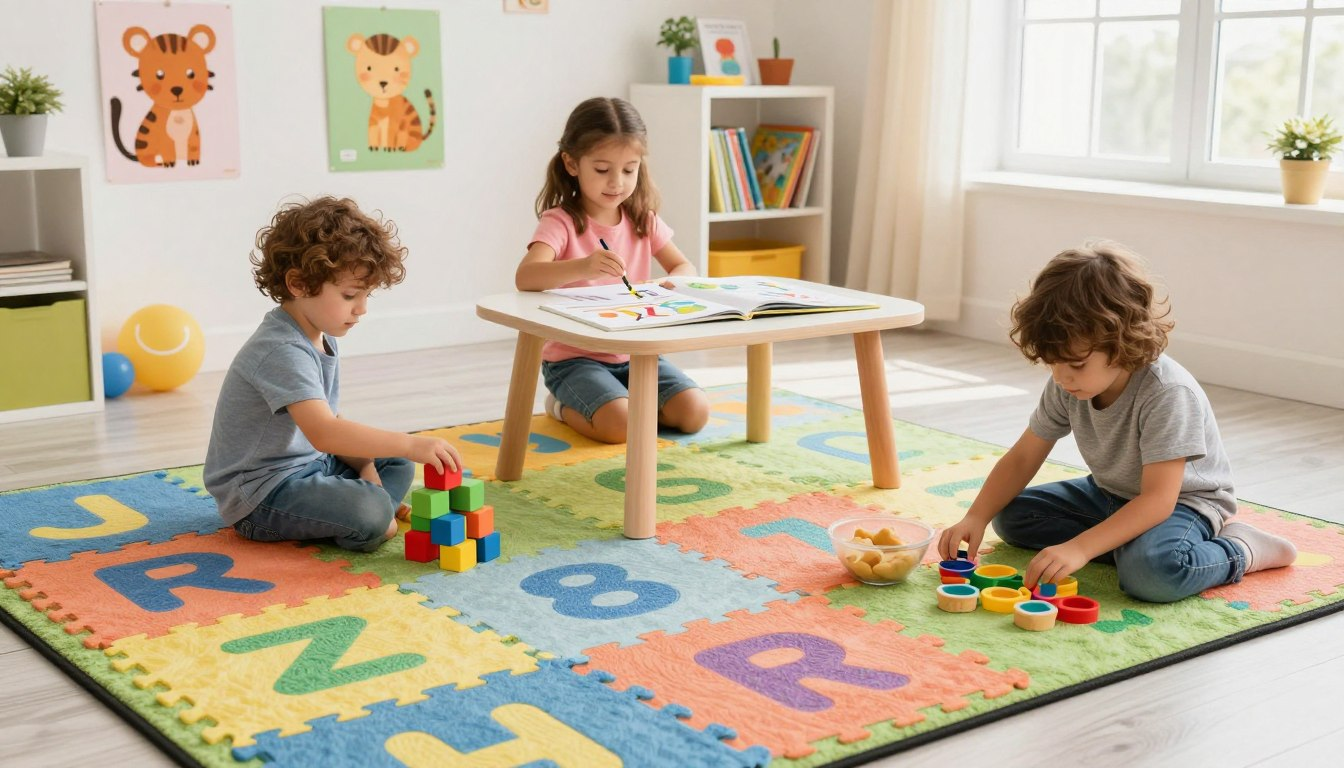
Teaching a three-year-old their letters does not require flashcards, workbooks, or an expensive learning subscription. It requires play — the kind that uses the child’s natural curiosity, their love of moving, touching, and discovering, and the ordinary materials already present in your kitchen, bathroom, and living room.
That matters practically, because the research is clear: hands-on, multi-sensory alphabet activities produce better letter retention in young children than passive methods. When a child traces a letter in shaving cream, jumps on a chalk letter on the driveway, or shapes playdough into the curve of a C, the experience is encoded in motor memory as well as visual memory. That kind of double-channel learning sticks far longer than drilling the ABC song repeatedly.
This guide covers twenty-plus activities organized by where they happen in your day — kitchen, living room, outdoors, bath time — so that learning the alphabet can slot naturally into routines you already have, rather than requiring a separate structured session.
Why Short, Active Sessions Beat Formal Instruction
Three-year-olds have working memory and attention spans that peak at around five to ten minutes per task. This is not a limitation to work around — it is a design feature of how early childhood brains build knowledge. Short, frequent, playful exposures to letters across different contexts throughout the day are more effective than a single longer session.
The goal at age three is familiarity and recognition, not mastery. Children this age are learning that letters exist, that each has a shape and a sound, and that letters appear on cereal boxes, street signs, and books. That environmental context is part of the learning. Pointing to the K on a box of crackers and saying its sound reinforces the same concept as a formal alphabet chart — but with the added benefit of connecting letters to the real world .
Short games also preserve the most important quality of early literacy learning: the child should feel successful and curious, not pressured. Any activity that creates resistance or frustration should be shortened, simplified, or temporarily shelved. Alphabet knowledge at three is built through hundreds of small, positive exposures — not through any single focused lesson .
Kitchen Alphabet Activities
The kitchen is genuinely one of the most resource-rich rooms in the house for letter learning. Cereal boxes, pasta, food packaging, refrigerator magnets, and kitchen tools all offer natural opportunities for casual, low-effort alphabet engagement.
Cereal Box Letter Hunt
Give your child an empty cereal box or any food packaging and a washable marker. Ask them to find and circle every letter A, or every letter in their name. This works across a wide range of literacy levels — younger children can look for a single letter, older preschoolers can hunt for all the vowels or trace every letter in a specific word .
Pasta Letter Matching
Write letters in large print on an index card or a piece of paper. Let your child arrange dry pasta pieces along the lines of each letter. This builds both letter shape recognition and fine motor control. Straight pasta works for letters like L, E, and H. Curved pasta shapes like elbow macaroni can outline rounded letters like C, O, and G.
Refrigerator Magnet Games
If you have magnetic letters on the fridge, use them as a quick daily touchpoint rather than a one-off activity. Ask your child to find the letter that starts their name. Call out a sound and ask them to bring you the matching letter. Hide three letters on a low shelf of the fridge and ask them to find them. These take under two minutes, require no setup, and add up to significant exposure across a week .
Kitchen Pot Sound Band
Pull out a few pots and wooden spoons and assign each pot a letter sound. Say a sound and ask your child to beat the correct pot. This is a phonics activity, not just a letter recognition activity — it links the sound to the symbol in an active, physical way. Loud, slightly chaotic, and very effective for auditory learners .
Sensory Alphabet Activities
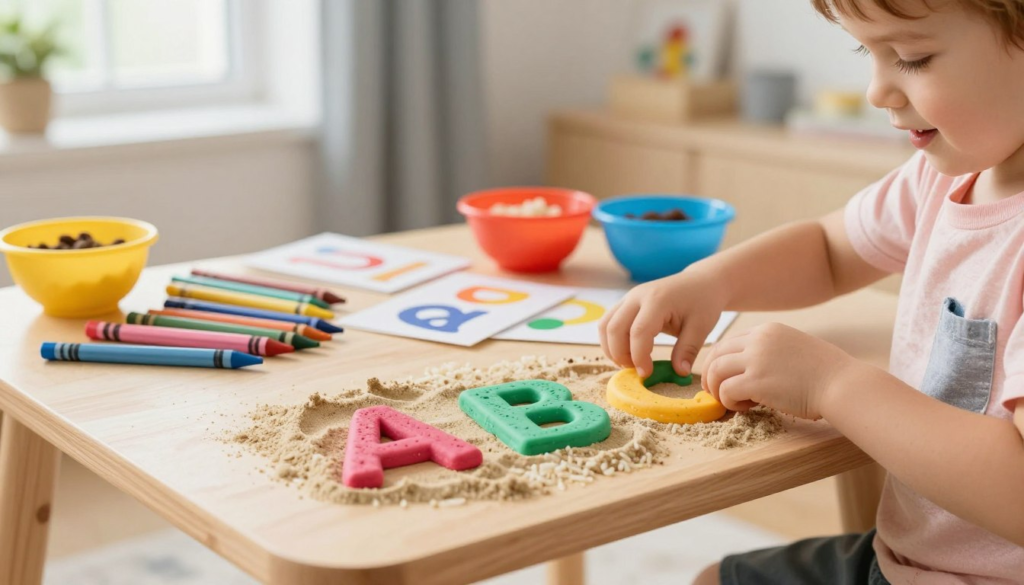
Sensory activities are among the most well-supported approaches in early childhood literacy research. When children form, trace, or feel letters rather than simply look at them, they build motor memory that reinforces visual recognition. As Maria Montessori observed, what the hand does, the mind remembers .
Shaving Cream Letter Writing
Spray a layer of shaving cream onto a smooth surface — a tray, a clean countertop, or a baking sheet. Ask your child to write a letter with their finger, or trace a letter you draw first. The sensory feedback from the cream makes the experience more engaging than writing on paper, and mistakes simply smooth away, which removes any pressure about getting it wrong .
Rice Bin Letter Discovery
Fill a shallow container with dry rice or dried lentils. Bury foam letter tiles, letter magnets, or small cardboard letters throughout the rice. Let your child dig, find, and identify each letter they uncover. For younger children, simply naming the letter is enough. For older preschoolers, ask for the letter sound or a word that starts with it .
Playdough Letter Shaping
Playdough is one of the most versatile letter-learning tools available and also one of the cheapest to make at home. Ask your child to roll and shape the dough into letters directly. For a more structured version, write large letters on a laminated sheet and have them press or roll the dough along the outlines of each letter. This version is particularly good for internalising letter shape, since the child is physically constructing the form rather than observing it .
| Activity | Materials Needed | Key Benefit |
|---|---|---|
| Shaving cream writing | Shaving cream, tray or baking sheet | Letter formation, fine motor skills |
| Rice bin letter search | Dry rice or lentils, container, letter tiles | Letter recognition, tactile exploration |
| Playdough letter shaping | Playdough, laminated letter sheets | Letter shape memory, hand strength |
Movement-Based Alphabet Games
Physical movement is not just a way to use up energy before sitting down to learn. For young children, movement and learning are not separate processes. When a child hops on the letter B, stomps during a B sound, or crawls to the correct letter on the floor, their whole body is encoding the information. These kinesthetic links are among the most durable forms of memory for children in this age group .
Floor Alphabet Hopscotch
Use painter’s tape or paper cards to create a floor grid and write one letter in each space. Call out a letter and have your child jump or hop to it. For a more advanced version, call out a letter sound rather than the letter name, requiring your child to make the connection between the two .
Freeze Dance with Letter Sounds
Play music and let your child dance freely. When the music stops, call out a letter or a letter sound. Your child must hold a frozen pose and repeat the sound back to you before dancing again. This combines phonological awareness with the physical self-regulation of the freeze game — a useful cognitive pairing .
Pillow or Cushion Letter Jump
Write letters on paper or card, place them on floor cushions or pillows, and ask your child to jump from letter to letter as you call them out. Safe, contained, and active. You can start with just five letters and gradually introduce more as recognition builds .
Alphabet Clapping and Stomping
Say a letter and its sound, clap or stomp, and ask your child to echo you. Progress to calling a word and asking them to identify and produce the first sound. This is a phonological awareness exercise that does not require any materials at all and can happen anywhere — in the car, at the dinner table, or during a walk .
Toy-Based Letter Learning
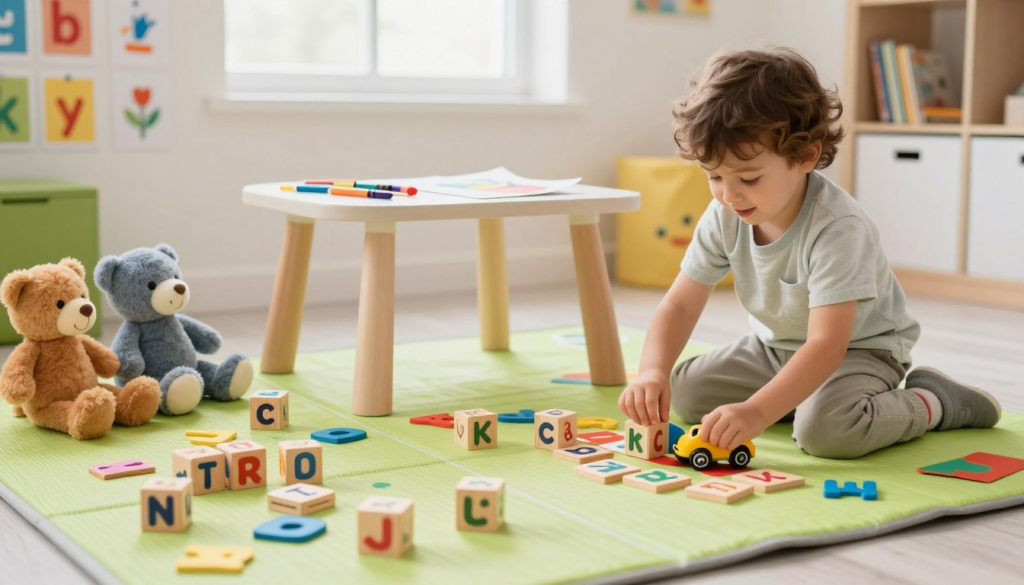
Integrating alphabet learning into toy play removes the transition cost of a separate learning activity. The child is already playing — the letter element gets added to what they are already doing .
Stuffed Animal Alphabet Parade
Line up stuffed animals and assign each one a letter card. As you march the animals in a “parade,” say each letter and a word that starts with it: “Bear starts with B — buh, buh, Bear.” The ritual of the parade, the familiar toys, and the letter-word link all reinforce each other. This works especially well for children who respond to narrative and imaginative play .
Building Block Letter Construction
Use rectangular blocks to build letters. This is trickier than it sounds and requires genuine attention to letter shape — the child has to mentally construct the form from component lines and curves. L, T, I, H, and E are the easiest starting shapes. Curved letters like B and D can be approximated and corrected .
Toy Car Letter Road Race
Lay letter cards on the floor in a line or loop and let your child drive a toy car past each letter, calling out the letter or sound as they pass. The drive-through format makes it easy to cycle through many letters quickly without it feeling like a quiz .
Paper-Based Letter Activities
Paper activities give children practice identifying letters in a variety of fonts and sizes, which is important because real-world text does not look like the neat capital letters on a classroom poster. Magazines, newspapers, and junk mail are free resources that expose children to the same letters in many different visual forms .
Magazine Letter Cut and Paste
Give your child an old magazine, safety scissors, and a glue stick. Ask them to cut out all the letter As they can find, or all the letters in their name, and paste them onto a sheet of paper. This builds recognition, fine motor control, and the important understanding that letters appear in different sizes, colours, and styles while remaining the same letter .
Newspaper Letter Circle Hunt
Give your child a page of newsprint and a washable marker. Ask them to circle every instance of a target letter. Younger children can work on a single large letter. Older preschoolers can hunt for a pair — both uppercase and lowercase versions of the same letter .
Salt or Sand Tray Letter Tracing
Pour a thin layer of salt or sand into a shallow tray or baking dish. Say a letter aloud, then demonstrate tracing it with your finger. Let your child trace the same letter, shake the tray to erase, and try the next one. This combines auditory input, visual demonstration, and tactile tracing — three channels of encoding in one simple exercise .
Outdoor Letter Activities
Outdoor environments expand the sensory richness of alphabet activities and give children who struggle to stay still indoors much more room to move. Most outdoor letter activities require almost no preparation .
Sidewalk Chalk Giant Letters
Draw letters large enough for a child to walk, jump, or trace along. Say the letter name, produce the sound, and have your child physically trace the letter’s shape by walking or jumping along the chalk lines. Scale is significant here — tracing a large letter with your body reinforces directionality and shape memory in a way that writing a small letter on paper does not .
Nature Stick Letter Formation
Collect sticks, pebbles, leaves, or pinecones on a walk and use them to form letters on the ground. This is an unstructured, exploratory activity that works well after a child already has basic familiarity with letter shapes — it asks them to reconstruct a shape from memory using natural materials .
Water Bottle Letter Bowling
Fill empty plastic bottles with a little sand or water to weight them and tape a letter card to each one. Line them up as pins. Call out a letter and let your child aim for the matching pin. This is a targeting activity, a movement activity, and a letter recognition activity at the same time .
Bath Time Letter Games
Bath time is one of the most underused learning windows in the daily routine. The combination of warm water, a contained space, and a naturally relaxed mood creates ideal conditions for low-pressure letter practice. Foam bath letters are the obvious tool, but there are other options if you do not have them .
Foam Bath Letter Stick and Spell
Wet foam letters stick to bath walls, tiles, and the side of the tub. Ask your child to put up all the letters in their name, find the letters you call out, or sort letters by colour or shape. These tasks take one to two minutes and require no supervision beyond normal bath safety .
Spray Bottle Letter Washing
Write letters on the bath tiles with a bath crayon or washable marker. Give your child a small spray bottle filled with water and ask them to spray and wash away the letters you call out. The physical act of aiming and spraying adds a motor challenge that makes the activity engaging .
Floating Cup Letter Scoop
Drop small waterproof letter cards or foam letters into the bath water and give your child a cup or small container. Ask them to scoop up a specific letter, all the vowels, or any letter they can name correctly. This combines hand-eye coordination with letter identification in a format that feels entirely like water play .
Phonics and Sound Recognition Activities
Letter name recognition and letter sound knowledge are related but different skills. Many children learn to recite the alphabet song long before they connect letters to sounds. Phonological awareness — the ability to hear and manipulate the sounds in spoken language — is actually a stronger predictor of early reading ability than letter name knowledge, and it can be developed entirely through listening and speaking games, no materials required .
First Sound Treasure Hunt
Name a sound and ask your child to find something in the room that starts with that sound. “Find something that starts with the sss sound.” This is more cognitively demanding than a letter hunt because the child has to hold the sound in working memory, scan their environment, and make a phonetic connection. Start with sounds whose objects are obvious, like /b/ for a ball or /c/ for a cup .
I Spy Letter Sounds
Adapt the classic “I spy” game by using first sounds instead of colours. “I spy with my little eye something beginning with the /t/ sound.” This is a zero-setup activity that works in the car, at a restaurant, at the supermarket, or anywhere else you happen to find yourselves .
Practical Tips for Making These Activities Work
- Follow the child’s interest. If they stop engaging, redirect or end the activity. Five engaged minutes is better than fifteen frustrated ones.
- Repeat is fine. Children learn through repetition. If your child wants to do the rice bin letter hunt three days in a row, that is a good sign, not a sign you need to introduce something new.
- Name letters casually throughout the day. Pointing to letters on packaging, signs, and books during normal routines provides important contextual exposure on top of dedicated activities .
- Do not correct in a way that creates shame. If your child misidentifies a letter, simply supply the correct answer warmly and move on. The goal is a positive association with letters, not accuracy under pressure.
- Lower-case letters matter. Most print that children encounter in books is lower-case. Once uppercase recognition is building, begin introducing lower-case versions of the same letters .
- Start with their name. The letters in a child’s name are almost always the first ones they recognise reliably. Use these as the anchor and build outward .
FAQ
What letters should I teach first to a three-year-old?
Start with the letters in your child’s first name. These are the letters a child will encounter most often in their own environment — on their belongings, in birthday cards, on labels — and they carry personal significance that helps memory. From there, move to high-frequency letters like S, A, T, and M, which appear often in beginner reading books .
Should I teach uppercase or lowercase letters first?
Uppercase letters are generally easier to distinguish visually and are a natural starting point. However, most books, labels, and environmental print use lower-case letters after the first character in a sentence or name. Introducing lower-case alongside uppercase gradually — rather than waiting to “finish” uppercase — gives children more useful real-world recognition skills sooner .
How do I know if my three-year-old is ready to learn letters?
Most three-year-olds show some natural interest in letters, particularly in their own name or in familiar logos and signs. The readiness signs to look for are curiosity about print — pointing at words, asking what they say, or noticing letters in the environment. Readiness is not a threshold to hit; it is a spectrum, and gentle, play-based exposure is appropriate for virtually all children in this age range .
Are digital alphabet apps useful or harmful at this age?
Most developmental guidance recommends minimising screen-based learning for children under five and prioritising hands-on, interactive activities instead. Digital apps can supplement recognition practice, but they do not build the fine motor skills, tactile memory, or spatial understanding that physical letter activities develop. If apps are used, co-viewing and interacting together is significantly more beneficial than passive solo use .
What if my child refuses to do alphabet activities?
Drop the activity without pressure and try a different format later. Resistance at this age often signals that the format is wrong for the child’s current mood or learning style rather than that the child is not ready for letters. A child who refuses to sit with paper and crayons may be enthusiastic about jumping on floor letter cards, scooping letters from a rice bin, or spotting letters on cereal boxes during breakfast .
How many letters should a three-year-old know?
There is no fixed standard, and comparison with other children at this age is not useful. Some three-year-olds know several letters; others know very few. What matters more than quantity is the quality of engagement with language — do they enjoy books, respond to stories, notice print in the environment, and play with sounds in words? These broader literacy behaviours are stronger early predictors of reading readiness than letter count .

Written by
Nouhaila Benis
Hey! I’m Nouhaila a children’s education teacher with over 5 years of classroom experience across multiple countries. She specialises in early literacy and phonics, with one clear goal: helping every child become a confident, independent reader one word at a time. As a full-time blogger, I share with you my best personal experiences.