
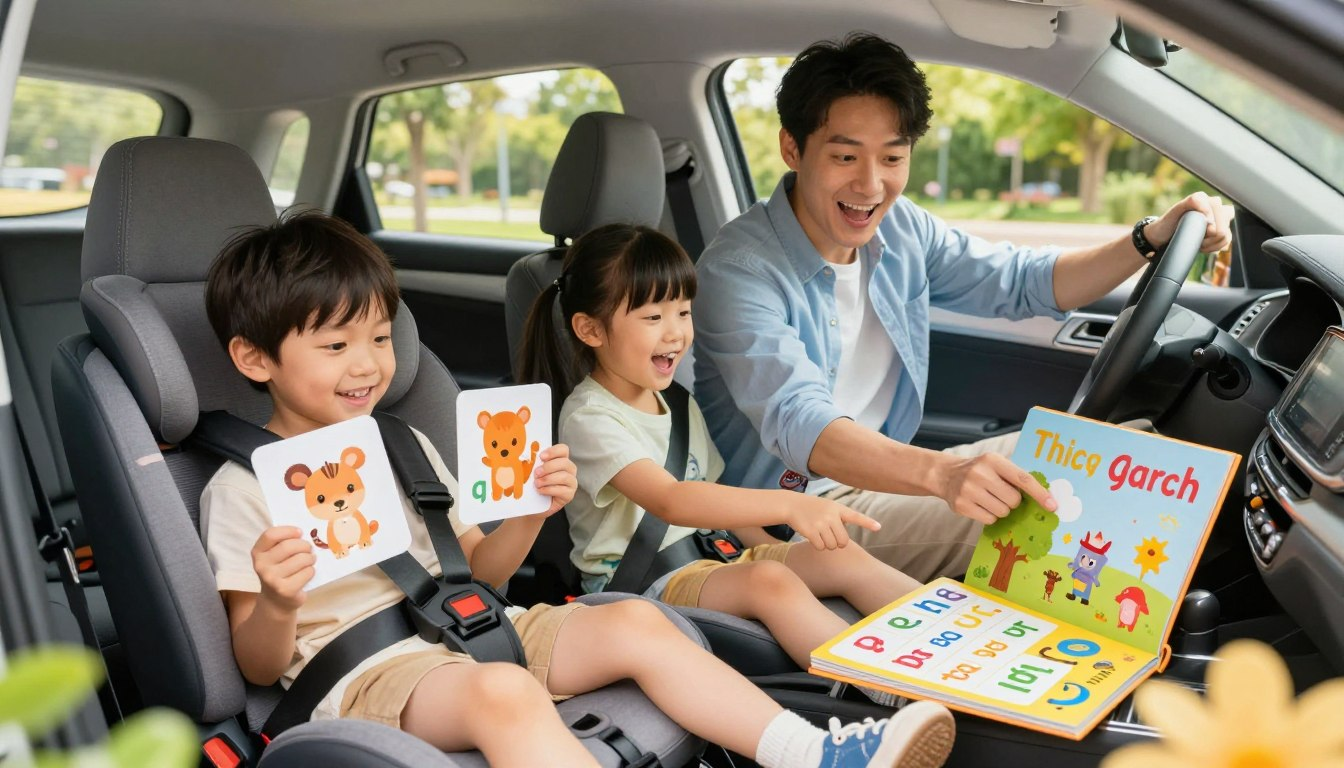
Car rides are one of the most underused learning opportunities in a young child’s day. There are no screens to compete with, no toys to distract from, and nowhere else to be. That combination of captive attention and relaxed setting turns out to be ideal for phonics — the foundational skill that underpins all early reading.
This guide covers more than twenty phonics games for preschoolers that require no preparation, no materials, and no apps. Everything is played with voices and imagination. The games are organised by skill level and phonics focus — beginning sounds, rhyming, blending, ending sounds, syllables, vowels, and word building — so you can choose the right activity for where your child is right now and progress naturally from there.
Key Takeaways
- Car time provides a distraction-reduced environment that is genuinely well-suited to verbal phonics practice.
- All games in this guide require zero preparation and zero materials — only your voice and your child’s imagination.
- Phonics games build phonemic awareness (hearing and manipulating sounds), which research consistently identifies as the single strongest predictor of early reading success.
- Games should be adjusted in real time to match your child’s current skill level — the ability to make a game easier or harder on the fly is one of the key advantages of verbal car games over apps or worksheets.
- Ages 3–4 benefit most from beginning sound and rhyming activities; ages 4–5 are ready for blending, ending sounds, syllables, and word manipulation.
- Enthusiasm and specific praise (“You heard that /t/ sound at the very end — well done”) are more effective than generic encouragement at this age.
Why Car Time Is Ideal for Phonics Practice
Most phonics instruction happens at a table with flashcards, worksheets, or a screen. Car rides offer something different: an enclosed, low-distraction space where a child’s attention is not being competed for and where learning can feel genuinely spontaneous rather than scheduled. There is no setup, no cleanup, and no transition time — you simply start talking.
Verbal phonics activities are also particularly well-suited to the car because they are purely auditory. A child does not need to see a letter to practise its sound. Hearing, isolating, blending, and manipulating sounds — the core skills of phonemic awareness — can all be developed through conversation and games alone. Many children who find table-based phonics tasks stressful respond with enthusiasm to exactly the same skills presented as a game during a car journey.
What These Games Actually Develop
| Phonics Skill | What It Means | Why It Matters |
|---|---|---|
| Phonemic awareness | Hearing and manipulating individual sounds in spoken words | The strongest predictor of early reading success — precedes letter-sound knowledge |
| Sound recognition | Identifying specific sounds at the beginning, middle, or end of words | Builds the foundation for decoding written words |
| Blending | Combining separate sounds into a complete word | Essential for reading — children must blend sounds to read any new word |
| Rhyme awareness | Recognising and producing words with matching end sounds | Develops sensitivity to sound patterns, which speeds up reading and spelling |
| Syllable awareness | Breaking words into beats | Helps with reading multi-syllable words and with spelling |
| Letter-sound association | Connecting a specific letter to its sound | The bridge between phonemic awareness and phonics — required for decoding print |
Beginning Sound Games
Beginning sound awareness is typically the first phonics skill to develop and the natural starting point for three and four-year-olds. These games train children to hear the first sound in a word — which is both easier to isolate than middle or ending sounds and directly transferable to the early stages of reading instruction.
I Spy with Sounds
Play the classic I Spy game with a phonics twist. Instead of saying “something beginning with the letter T,” say “something beginning with the /t/ sound” — emphasising the sound rather than the letter name. This distinction matters: children who are secure with letter sounds before letter names tend to decode more fluently. Objects visible through the car window, on signs, or inside the car are all fair game. For younger children, confirm the answer warmly whether they are right or close; the goal is engagement with sounds, not accuracy under pressure.
First Sound Scavenger Hunt
Choose a target sound and challenge your child to spot as many things as possible that start with it before you reach your destination. “How many things can you find that start with the /s/ sound?” Scavenger hunts work especially well on longer journeys because they sustain attention across time rather than requiring a single correct answer. Keep a running count together and celebrate the total at the end of the journey.
Alliteration Adventure
Take turns building a silly phrase where every word starts with the same sound. “Six slippery snails sliding slowly” — then your child adds a word that continues the pattern, or starts a new phrase of their own. Alliteration games are highly engaging for preschoolers because the silliness of the resulting sentences is genuinely funny to them, which means they will happily repeat the activity across multiple journeys.
| Game | Core Skill | Best Age |
|---|---|---|
| I Spy with Sounds | Beginning sound identification | 3–5 |
| First Sound Scavenger Hunt | Beginning sound recognition, observation | 3–5 |
| Alliteration Adventure | Phonemic awareness, language play | 4–5 |
Rhyming Games
Rhyme awareness develops slightly later than beginning sound awareness for most children, but it is an equally important phonemic skill. Children who can rhyme fluently have demonstrated that they can hear and manipulate the end-sound patterns of words — a skill that directly accelerates spelling and reading development.
Rhyme Time Challenge
Say a word and ask your child to find as many rhyming words as they can. “How many words can you think of that rhyme with ‘cat’?” Nonsense words that genuinely rhyme — “zat,” “brat,” “gnat” — count and should be celebrated. Children who produce nonsense rhymes are demonstrating that they understand the phonological pattern independently of meaning, which is exactly the skill you are trying to build. For an added challenge, limit rhymes to words within a category: “What foods rhyme with ‘cake’?”
Word Family Chain
Start with a word and take turns adding words from the same word family — words that share the same ending sound pattern. “Cat — hat — mat — rat — sat.” Each person adds one word; the chain continues until nobody can think of another. Then choose a new starting word from a different family. This game is particularly powerful because it introduces children naturally to the concept of word families, which is a major organising principle in early reading instruction.
| Starting Word | Word Family Chain |
|---|---|
| cat | hat, mat, rat, sat, flat, that |
| play | say, way, day, bay, hay, stay |
| dog | log, bog, fog, jog, frog, blog |
| hop | top, pop, stop, shop, drop, crop |
Silly Rhyme Story Building
Start a two-line rhyming story and ask your child to complete the second line. “There once was a dragon who lived in a cave — he breathed out some fire and started to…” Your child fills in the rhyme: “wave,” “behave,” “rave.” The game combines rhyme awareness with narrative creativity, and the unpredictability of what your child comes up with is usually entertaining enough to keep both of you engaged for the length of the journey.
Letter Sound Recognition Activities
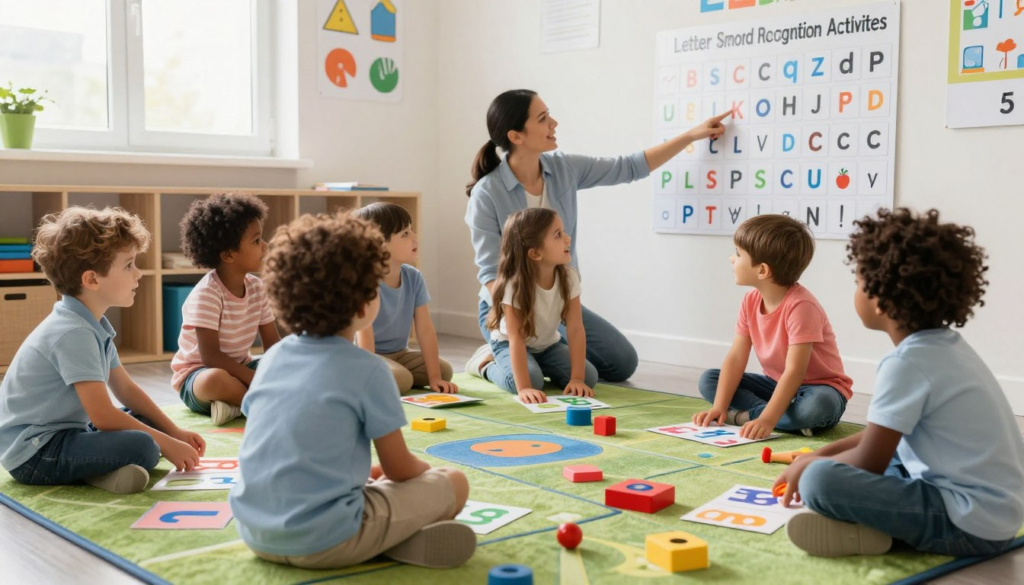
Letter-sound activities build the bridge between the purely auditory phonemic awareness games above and the print-based phonics work children will encounter in school. These games connect specific sounds to their corresponding letters without requiring a child to read — they are designed to be played by looking at the world outside the car window.
Alphabet Road Trip
Spot letters on road signs, shop fronts, number plates, and lorries. When you find a letter, say its sound together rather than its name: “There’s a T — it makes the /t/ sound.” Work through the alphabet in order for a structured version, or spot letters at random and race to say the sound first for a more energetic one. Children who regularly connect printed letters to their sounds during incidental activities like this tend to build letter-sound knowledge faster than those who only encounter letters in formal instruction.
Sound Sorting Game
Say a series of words and ask your child to raise their hand — or tap the seat — every time they hear a word that starts with a target sound. “I’m going to say some words. Every time you hear a word that starts with the /p/ sound, tap your knee: pen, dog, pink, cat, puppy, table, parrot.” This game develops the discrimination skill of isolating a specific sound within a stream of words — a more demanding task than identifying beginning sounds in isolation and an important step toward reading fluency.
Letter of the Day Challenge
Choose one letter each morning and make it the focus of every car journey that day. Introduce the sound at the start of the ride, then look for it on signs, name things that start with it, and count how many you find. Returning to the same letter throughout the day — across multiple short journeys — builds much stronger retention than encountering each letter once. By the end of the week, five letters have been given extended, contextual, repeated exposure, which is considerably more effective than brief introduction of all twenty-six.
Blending Games
Blending — the ability to push separate sounds together to form a complete word — is the core decoding skill in reading. A child who can hear “/k/ /a/ /t/” and say “cat” has demonstrated the fundamental mechanism of word reading. These games practise exactly that skill, entirely through listening and speaking.
Robot Talk Game
Speak in a robotic voice that separates every sound in a word with a deliberate pause: “/d/ — /o/ — /g/.” Ask your child to blend the sounds together and tell you the word. Start with simple three-sound (CVC) words like “cat,” “sun,” “big,” “hop.” As your child becomes confident, move to four-sound words: “frog,” “step,” “clap.” The robotic framing removes any sense of a test and turns the activity into a game of deciphering a robot’s message — a premise that most preschoolers find delightfully engaging.
Sound Stretching Exercise
Stretch a word out slowly so each sound is audible and sustained: “mmmm — aaaaa — t.” Ask your child to say the word at normal speed. The stretching makes the individual phonemes within a word audible in a way that normal speech does not, which is exactly what children need in order to develop awareness of the sound structure hidden inside everyday words. This is a useful preparation activity before the Robot Talk Game — it makes the segmentation process feel more natural.
Blend and Guess
Think of an object — something in the car or visible through the window — and give your child its sounds one at a time: “/s/ /ee/ /t/.” They blend and guess: “Seat!” Then swap roles: your child thinks of an object and tries to give you its sounds. The role reversal is particularly valuable because producing segmented sounds is harder than blending them, and the challenge of working in both directions significantly accelerates phonemic awareness development.
Ending Sound Games
Ending sounds are consistently harder for young children to isolate than beginning sounds, because the beginning of a word is the part that receives the most acoustic emphasis in speech. These activities are appropriate once a child is confident with beginning sounds and is ready for a greater challenge.
Last Sound Detective
Say a word and ask your child to identify its final sound. “What is the very last sound you hear in ‘dog’?” The answer is /g/ — not the letter name “gee,” but the sound the letter makes. Emphasise that you want the sound, not the letter name. Start with words that end in clear, sustained sounds (/m/, /n/, /s/, /l/) before moving to more abrupt endings (/t/, /p/, /k/), which are harder to isolate because they cannot be held.
Ending Sound Match-Up
Say two words and ask: “Do these end with the same sound?” Use pairs that clearly match (“bus” and “glass” — yes, both end in /s/) and pairs that do not (“cat” and “car” — no, one ends in /t/ and one in /r/). Include some near-misses to sharpen discrimination: “hat” and “had” end in similar but different sounds (/t/ versus /d/). These minimal-pair comparisons are excellent for training the precision of auditory discrimination that underpins accurate spelling.
Final Sound Freeze
Say a series of words that all end with the same sound, and tell your child to “freeze” (go silent) the moment you say a word that breaks the pattern. “Dog, log, fog, jog, frog… cat.” The anticipation of the break keeps children listening carefully to every word in the sequence, which is significantly more demanding than identifying the ending sound of a single word in isolation.
Syllable Clapping and Counting Games
Syllable awareness is a distinct but related skill to phoneme awareness. While phoneme-level games focus on individual sounds, syllable games focus on the rhythmic beats of words. Children who can segment and count syllables reliably find multi-syllable words significantly less intimidating when they encounter them in reading and spelling.
Syllable Stomp Along
Say a word and clap, tap a knee, or stamp a foot for each syllable. “Ba-na-na” — three claps. “Hel-i-cop-ter” — four claps. The physical rhythm reinforces the segmentation, which is why tapping or clapping almost always produces more accurate syllable counting than simply asking a child to count beats mentally. For car rides, tapping a knee or patting the seat is more practical than clapping.
Name Game Syllables
Tap out the syllables in the names of family members, friends, pets, and favourite characters. “Gran-ma” — two taps. “Al-ex-an-der” — four taps. “Mar-shall from PAW Pa-trol” — five taps. Names are a particularly motivating category for preschoolers because they already care about them and have heard them many times, which makes the syllable structure easier to detect. This game also works well because it generates natural conversation about people and characters your child loves.
Traffic Light Syllables
Assign colours to syllable counts: one syllable is red, two is yellow, three or more is green. Call out a word and ask your child to shout the colour — and you can play it in reverse with real traffic lights outside the window: when the light turns red, name a one-syllable word; yellow, two syllables; green, three or more. The connection to the environment outside the car makes this game feel spontaneous and physically engaged rather than task-based.
| Game | Description | Skill Level |
|---|---|---|
| Syllable Stomp Along | Tap or clap for each beat in a word | Beginner |
| Name Game Syllables | Count beats in names of people and characters | Intermediate |
| Traffic Light Syllables | Match syllable count to traffic light colour | Advanced |
Vowel Sound Discovery Activities
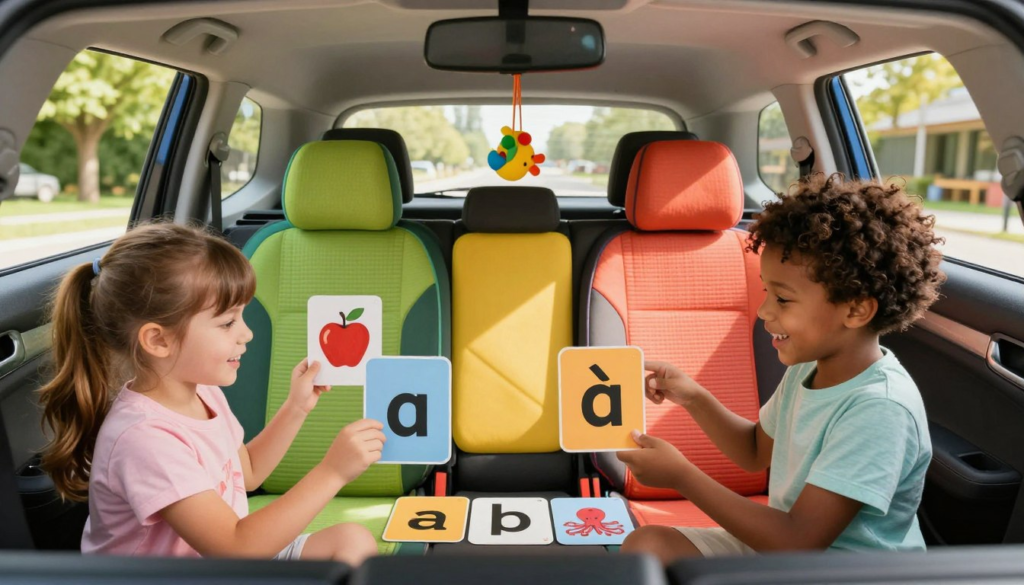
Vowel sounds are among the most complex phonics concepts for young children because vowels are inconsistent — the letter “a” alone represents different sounds in “cat,” “cake,” “car,” and “ball.” These activities focus on building awareness of short and long vowel sounds through listening, without requiring any understanding of spelling rules, which come much later.
Short Vowel Hunt
Focus on one short vowel sound per journey. “Today we are listening for the short /a/ sound — like in ‘cat.’ Can you think of words with that sound in the middle?” Give examples to anchor the sound: “hat, map, bag, tap.” Then ask your child to generate their own. Short vowels in the middle of CVC words (consonant-vowel-consonant) are the most important phonics pattern in early reading, and this activity builds awareness of each vowel sound before a child encounters them in print.
Vowel Sing-Along
Adapt a familiar song to feature a specific vowel sound. Sing “Old MacDonald had a farm, /a/ /a/ /a/ /a/ /a/” substituting vowel sounds for the “E-I-E-I-O” section. Or choose a simple tune and replace every vowel in the lyrics with a single sound: “Baa baa black sheep” becomes “Baa baa blick sheep” when everything is short /i/. The song format makes sounds memorable in a way that repetition alone does not, and most children who have sung a vowel-sound song can recall the sound it featured days later.
Vowel Sound Sorting
Say pairs of words and ask whether they share the same vowel sound in the middle. “Hat and map — same middle sound or different?” (Same: short /a/.) “Hat and hit — same or different?” (Different: short /a/ versus short /i/.) This discrimination task is harder than it sounds, and it directly builds the auditory precision that children need to sort words into spelling patterns — one of the core activities of early phonics instruction.
| Vowel Sound | Example Words |
|---|---|
| Short /a/ | cat, hat, map, bag, tap |
| Long /a/ | cake, make, rain, day, play |
| Short /e/ | pet, met, set, bed, red |
| Short /i/ | sit, hit, big, pin, lip |
| Short /o/ | hot, dog, top, pop, fog |
Word Building Games
Word building games are the most advanced activities in this guide and are best suited to children aged four and a half to five who already have solid beginning-sound awareness and basic blending skills. They practise phoneme manipulation — the ability to add, remove, or swap individual sounds within words — which is one of the highest-level phonemic awareness skills and directly prepares children for reading and spelling unfamiliar words independently.
Change One Sound Game
Start with a simple word and ask your child to change one sound to make a new word. “We have ‘cat.’ What happens if we change the /k/ to a /b/? What word do we get?” (Bat.) “Now change the /a/ to an /i/.” (Bit.) “Now change the /t/ to an /n/.” (Bin.) A single starting word can produce a long chain of new words, each requiring only one sound change. This game builds the understanding that words are made of moveable parts — a conceptual breakthrough that makes learning to spell feel logical rather than arbitrary.
- cat → bat → bit → bin → pin → pan → tan → tin
Add-a-Sound Builder
Start with a two-sound combination (“at”) and ask your child to add a sound to the front to make a real word. “If I add /m/ to ‘at,’ what word do I get?” (Mat.) “What about /f/?” (Fat.) “What about /fl/?” (Flat.) Start with single sounds before moving to consonant clusters, which are significantly harder. This game directly models the phonics skill of onset and rime — blending the initial consonant(s) with the vowel-ending pattern — which is a major strategy taught in early reading.
Sound Swapping Challenge
Give a word and ask your child to swap the ending sound for a different one. “We have ‘bat.’ Change the /t/ at the end to a /d/.” (Bad.) “Now change the /d/ to an /n/.” (Ban.) This is a more demanding version of the Change One Sound Game because it requires the child to hold the original word in working memory while simultaneously replacing a specified part of it — a cognitive load that exercises both phonemic awareness and verbal working memory, both of which are strongly linked to reading progress.
Sound Discrimination Challenges
Sound discrimination — the ability to tell phonetically similar sounds apart — is a prerequisite for accurate spelling and for avoiding the confusion of similar-sounding words in reading. These games target the precision of auditory processing in a way that the broader phonemic awareness games above do not.
Same or Different Sounds
Say two words and ask whether they start (or end) with the same sound. Keep it simple at first: “cat” and “car” — same beginning? (Yes.) “cat” and “bat” — same beginning? (No.) Progress to harder pairs that involve phonetically similar sounds: “pat” and “bat” (different: /p/ and /b/ are easily confused because they are produced in almost the same way), “fan” and “van” (/f/ and /v/), “ten” and “den” (/t/ and /d/). These minimal pairs are the most effective tool for sharpening auditory discrimination in young children.
Odd One Out
Say three words and ask your child to identify which one does not belong because it starts (or ends) with a different sound. “Sun, sit, ball — which one doesn’t fit?” (Ball.) “Dog, doll, cat — which is the odd one out?” (Cat.) Make it gradually harder by using words that are closer to each other: “pin, pig, bin — odd one out?” (Bin — starts with /b/ while the others start with /p/.) The near-miss version requires genuinely careful listening and is excellent preparation for the kind of phonetic attention spelling demands.
Beginning, Middle, or End Position Game
Give your child a target sound and a word, and ask where in the word they can hear the target sound — at the beginning, middle, or end. “Where do you hear the /n/ sound in ‘banana’?” (Middle and end.) “Where is the /s/ in ‘sun’?” (Beginning.) “Where is the /t/ in ‘cat’?” (End.) This positional awareness directly maps to the way children are taught to segment words for spelling — beginning sounds first, then ending sounds, then middle sounds — so building this awareness verbally before it is required in writing is a significant advantage.
Age-Appropriate Adaptations
| Age Group | Best Games | Adjustment Tips |
|---|---|---|
| Ages 3–4 (early phonemic awareness) | I Spy with Sounds, First Sound Scavenger Hunt, Rhyme Time Challenge, Syllable Stomp Along, Alliteration Adventure | Use familiar words only; confirm answers warmly; keep rounds short (2–3 words); celebrate all attempts |
| Ages 4–5 (ready for blending and manipulation) | Robot Talk, Blend and Guess, Word Family Chain, Change One Sound, Traffic Light Syllables, Sound Discrimination games | Introduce consonant clusters; ask your child to take the “teacher” role; increase word length gradually; use words from topics they are interested in |
| Any age (adjustment in real time) | Any game in this guide | Too easy: use longer words, introduce clusters, ask for more examples. Too hard: reduce word length, give extra clues, go back to a simpler game without comment |
Tips for Keeping Your Child Engaged
Use Specific Praise
Generic praise (“well done,” “good job”) is less effective at this age than praise that names what the child actually did. “You heard that tiny /t/ sound right at the end of ‘cat’ — that is really careful listening” tells your child what skill they demonstrated and what to repeat. It also communicates that the goal is listening carefully, not guessing correctly — which makes children more willing to attempt difficult tasks.
Rotate Games to Maintain Interest
No game stays engaging indefinitely for a preschooler. Switching activities every few minutes — moving from I Spy to Robot Talk to Alliteration Adventure — maintains novelty and prevents the resistance that comes when a game starts to feel like a drill. Having three or four games in rotation for a given journey is more effective than playing one game for the whole ride.
Connect Games to Their Interests
Use words and names from your child’s current favourite characters, shows, and interests wherever possible. A child who loves dinosaurs will engage far more readily with “What does ‘stegosaurus’ start with?” than with a random word they have no connection to. Interest-based vocabulary also naturally produces longer, more complex words — which provides phonics practice at a higher level than everyday CVC words without requiring any adjustment to the game format.
Handle Frustration by Reducing Difficulty Immediately
When a child is clearly struggling with a game, the most effective response is to make the next example easier without drawing attention to the difficulty. Switch to a shorter word, give a broad hint, or simply model the answer yourself and move on: “The /s/ sound — like in ‘sun.’ Your turn: what starts with the /s/ sound?” Maintaining momentum and a positive association with the activity is more important than completing any particular challenge at the correct difficulty level.
FAQ
What age should I start phonics games in the car?
Simple rhyming and beginning-sound games are appropriate from around age three. Most three-year-olds enjoy the Rhyme Time Challenge and I Spy with Sounds without any phonics background — the games are accessible because they feel like play rather than instruction. More demanding games (blending, word building, vowel sorting) are better suited to ages four and five, once a foundation of sound awareness is established.
Are these games still useful if my child is already in kindergarten?
Yes. Children in kindergarten benefit significantly from phonemic awareness practice that reinforces what they are learning in the classroom. The blending, word building, and sound discrimination games in this guide align directly with early reading instruction and provide the kind of repeated, low-pressure practice that consolidates classroom learning. Use your child’s current reading list as a source of words for the games — connecting car-time phonics to books they are actively reading produces the fastest results.
How long should each session be?
Match the session to the journey. A five-minute school run can accommodate one or two short games. A longer journey can sustain twenty to thirty minutes of varied activity with regular game-switching. The key constraint is your child’s engagement — stop a game the moment interest drops, switch to a different one, and end the session while things are still going well. Ending on a positive note makes the next journey easier to start.
Can I supplement car games with online phonics apps?
Platforms like ABCmouse, Khan Academy Kids, and Teach Your Monster to Read offer structured phonics practice that complements verbal car games well. The car games build the auditory phonemic awareness that makes app-based letter-sound activities more meaningful; the apps reinforce the print connection that the verbal games cannot provide. The combination of both — screen-based phonics at home and verbal games in transit — tends to produce faster progress than either approach alone.
What if my child is not interested in playing?
Do not force participation. Introduce a game as something you are doing yourself — “I’m going to try to find ten things that start with the /s/ sound on this journey” — and let your child join in when their curiosity is triggered. Children who observe a parent playing an obviously enjoyable game almost always want to participate within a minute or two. Making the activity visibly fun for you is more effective than directing it at them.

Written by
Nouhaila Benis
Nouhaila is a children’s education teacher with over 5 years of classroom experience across multiple countries. She specialises in early literacy and phonics, with one clear goal: helping every child become a confident, independent reader — one word at a time.