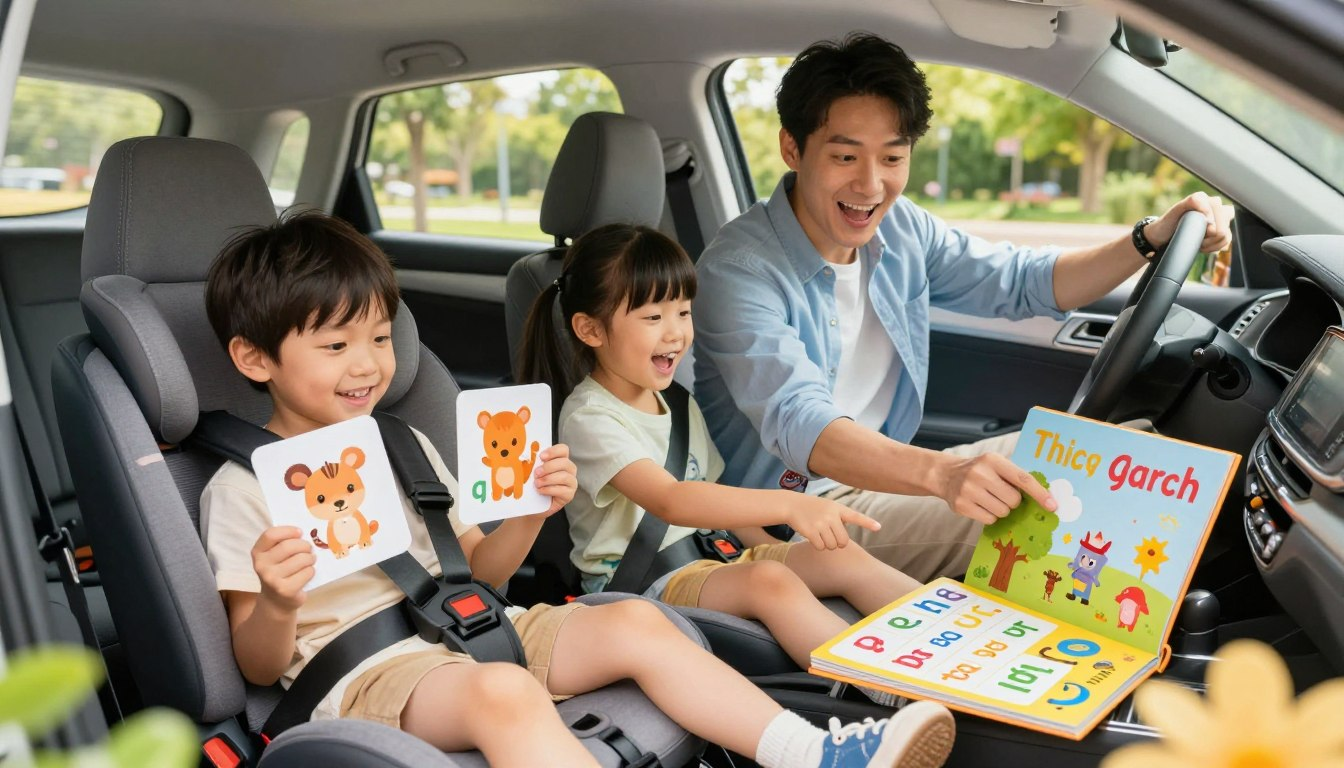
You hold the steering wheel and drive through the busy morning. Your child kicks the back of your seat. These long minutes stuck in traffic can be stressful. But, they are a golden opportunity to teach your child.
Instead of giving a tablet, you can make your car a classroom. This simple change helps you bond and teach your child important skills. They will use these skills forever.
Sound-play activities are more than just a distraction. Research shows that engaging phonics games for early learners help a lot. By teaching letter sounds now, you give your child a big advantage before they start kindergarten.
This guide shows how to help preschoolers learn language during your daily trips. You’ll find easy ways to practice without extra supplies, toys, or screens. Let’s make those boring rides fun and educational today.
Why Car Time Is Perfect for Phonics Practice
Car time is a great chance to make travel fun and educational for your child. You can turn boring car rides into exciting educational phonics activities. This helps your child love reading and learning.
The Benefits of Learning on the Go
Learning phonics on the go has many benefits. It turns idle time into learning moments. It also helps your child focus and learn in new places.
Playing interactive phonics games in the car is a great way to bond. It makes learning fun and creates happy memories.
How Phonics Games Build Early Reading Skills
Phonics games help build key reading skills. They improve your child’s sound recognition, blending, and letter-sound knowledge. These skills are vital for early reading.
| Skill Developed | Description | Example Activity |
|---|---|---|
| Sound Recognition | Identifying individual sounds within words. | Identifying the first sound in a word. |
| Blending Sounds | Combining individual sounds to form a word. | Blending sounds to say a complete word. |
| Letter-Sound Association | Understanding the relationship between letters and sounds. | Matching letters to their corresponding sounds. |
No Prep, No Materials, All Fun
Phonics games for car rides are easy and fun. They need no preparation or materials. You can play fun phonics games with just your voice and your child’s imagination.
By adding these activities to your car rides, you make learning fun. Your child will be ready for reading success without extra resources.
Beginning Sound Games to Start Your Journey
Starting a phonics journey with your preschooler is exciting. It begins with fun beginning sound games. These games help with early reading skills and can be part of daily activities like car rides. They focus on the sounds of words, which is key for reading and spelling.
These games are not only fun but also fit different ages and skills. They help kids see that words start with sounds. This makes them better at telling sounds apart. Here are some fun games to start with:
I Spy with Sounds
“I Spy with Sounds” is a fun game that makes kids listen for word sounds. For example, you might say, “I spy with my little eye something that starts with the /k/ sound.” They then guess the object, like “cat” or “kite.” It’s great for learning sounds and can be played in the car.
First Sound Scavenger Hunt
Make your car ride a “First Sound Scavenger Hunt.” Ask your child to find and name items that start with a sound. For example, find things that start with the /t/ sound. It’s good for phonics and helps with vocabulary and observation.
Alliteration Adventure
Alliteration is fun with beginning sounds. Make a phrase together, like “five feisty felines” or “seven sleepy sloths.” Take turns adding words that start with the same sound. It’s a fun way to learn sounds and enjoy language together.
Here’s a table to show how these games work and their benefits:
| Game | Description | Skill Developed |
|---|---|---|
| I Spy with Sounds | Guessing an object based on its initial sound | Phonemic Awareness |
| First Sound Scavenger Hunt | Finding objects that start with a specific sound | Phonics, Observation |
| Alliteration Adventure | Creating phrases with words starting with the same sound | Phonemic Awareness, Language Skills |
These games are just the beginning of your phonics journey. They’re easy to add to your daily routine. They can be changed to fit your child’s age and skill. By making phonics fun, you’re helping your child succeed in reading and literacy.
Rhyming Games That Make Miles Fly By
Rhyming games make car rides fun and good for preschoolers. They help kids love language and get better at reading. It’s a great way to make learning fun.
Playing rhyming games in the car is fun and teaches a lot. It helps kids learn how words sound. This is key for reading and spelling.
Rhyme Time Challenge
The Rhyme Time Challenge is a fun game. You say a word, and your child finds a word that rhymes. For example, “cat” might make them say “hat” or “mat.”
To make it harder, you can give clues or pick a theme. Like, “What food rhymes with ‘cake’?” They might say “stake” or “make.”
Word Family Chain
The Word Family Chain game is about linking words that sound the same. Starting with “cat,” you can say “hat,” “mat,” “rat,” and more. It teaches kids about word patterns.
| Start Word | Rhyming Words |
|---|---|
| cat | hat, mat, rat, sat |
| play | say, way, day, bay |
| dog | log, bog, fog, jog |
Silly Rhyme Story Building
Silly Rhyme Story Building is a game where you start a story and stop. Then, your child adds a sentence that rhymes. For example, “Once upon a time in a land far away, there was a magical kingdom in play,” and they could say, “Where creatures danced and played all day.”
This game boosts creativity and rhyming skills. It’s a great way to use your child’s imagination while learning.
Adding these rhyming games to car rides makes learning fun. They help preschoolers with phonics and reading. It’s a great way to spend time together.
Letter Sound Recognition Activities

As you keep learning with phonics games for preschoolers, it’s time to try letter sound recognition activities. These can be fun and educational, helping your child learn phonics in a fun way.
Learning letter sounds is key to reading and spelling. It’s about knowing the sounds letters make. Games and activities that focus on this can help your child read and write better.
Alphabet Road Trip
Start an Alphabet Road Trip with your preschooler. Look for letters on signs and license plates. This teaches letter recognition and sounds.
For example, say “Look, there’s the letter ‘T’! It makes the /t/ sound.” Make it fun by creating a checklist of letters for your child to find.
Sound Sorting Game
The Sound Sorting Game is a fun phonics activity for the car. Say words and ask your child to find ones that start with a sound. For example, find words that start with /k/.
| Sound | Example Words |
|---|---|
| /k/ | cat, kite, car |
| /t/ | tap, tot, turtle |
| /p/ | pen, pink, puppy |
Letter of the Day Challenge
The Letter of the Day Challenge is simple yet effective. Choose a letter each day and focus on its sound and words. For example, if it’s “D,” say the /d/ sound and think of words starting with it.
To make it more fun, ask your child to think of words or find objects that start with the letter’s sound.
These activities make learning phonics fun in the car. They help with reading and spelling and make learning enjoyable for your child.
Phonics Games for Preschoolers Using Blending Skills
When your preschooler gets better at hearing sounds, it’s time for phonics games. These games help them blend sounds into words. This is key for learning to read.
Playing fun games in the car is a great way to practice. These games boost phonics skills and make learning fun for your child.
Sound Stretching Exercise
The Sound Stretching Exercise is a fun game. It stretches out sounds in a word and then blends them. For example, “mmmm-aaaa-t” becomes “mat.”
This game helps your child get better at hearing sounds. It shows how sounds make words.
Robot Talk Game
The Robot Talk Game is another fun activity. You say a word in a robotic way (like “c-a-t”). Then, your child blends the sounds to say the word.
This game is not only fun. It also helps your child learn to decode words by blending sounds.
Blend and Guess
Blend and Guess is a guessing game. You give your child sounds (like “b-ee-n”). They have to guess the word.
This game makes phonics skills better. It also helps your child think about how sounds make words.
Ending Sound Games for Advanced Learners
Make your child’s phonics skills better with fun ending sound games. These interactive phonics games are great for advanced learners. They help improve phonics skills.
Here are some fun activities to try:
- Last Sound Detective: Ask your child to find the last sound in words. For example, “What is the last sound in ‘cat’?”
- Ending Sound Match-Up: Make pairs of words that end the same. Like “cat” and “hat.” Ask your child to find the matches.
- Final Sound Freeze: Say a word, and your child must say a word that ends the same. For example, “dog” might be “log.”
Last Sound Detective
This game helps your child focus on the last sound in words. It’s a key skill for advanced phonics. You can make it harder by using words with similar sounds.
Ending Sound Match-Up
This activity boosts your child’s hearing and phonics skills. You can use your own word lists or common words from car rides.
Final Sound Freeze
This game is a fun twist on word association and phonics. It makes your child think creatively and learn about ending sounds.
These educational phonics activities make learning fun. They also help you bond with your child on car rides. By adding these games to your daily routine, you support your child’s phonics growth in a fun way.
Syllable Clapping and Counting Games
Syllable clapping and counting games are fun for kids in cars. They help with phonics and make learning fun.
These games help your child learn to read and spell. They learn to break down words into syllables.
Stomp Along with Syllables
The “Syllable Stomp Along” game is a fun way to count syllables. You can stomp your feet or clap hands for each syllable. For example, “banana” has three syllables: ba-na-na.
This game works with any word. It’s great for car rides.
Name Game Syllables
The “Name Game Syllables” game is fun too. It involves clapping or counting syllables in names. Start with your child’s name and then others.
This game helps with syllable counting and remembering names.
Traffic Light Syllables
In the “Traffic Light Syllables” game, colors match syllable counts. One syllable is red, two is yellow, and three or more is green. Say a word, and your child calls out the color.
This game makes counting syllables fun and can be adjusted for different levels.
| Game | Description | Skill Level |
|---|---|---|
| Syllable Stomp Along | Clap or stomp to mark syllables in words | Beginner |
| Name Game Syllables | Count syllables in names | Intermediate |
| Traffic Light Syllables | Identify syllable count and call out corresponding color | Advanced |
These games are not only fun phonics games but also help preschoolers learn. They make car rides fun and help with reading skills.
Vowel Sound Discovery Activities

It’s time to explore vowel sounds with your preschooler. Learning vowel sounds is key for reading and spelling. Fun activities can make learning vowel sounds exciting, even on car rides.
These activities are fun, easy, and fit your child’s level. By doing vowel sound activities daily, you help your child get better at phonics. This is important for their reading skills.
Short Vowel Hunt
The Short Vowel Hunt is a fun game. It’s about finding words with short vowel sounds. For example, look for the short “a” sound in “cat,” “hat,” or “mat.”
This game helps your child recognize vowel sounds. It also makes them better at listening.
Vowel Sing-Along
Singing is great for learning, and the Vowel Sing-Along is a fun way to teach vowel sounds. Make a simple song that shows different vowel sounds, like “The long ‘e’ sound is in ‘me’ and ‘see’.” Singing together makes learning vowel sounds fun and easy to remember.
Vowel Sound Sorting
Vowel Sound Sorting is another good activity. It helps your child tell vowel sounds apart. Make a game by listing words with different vowel sounds. Ask your child to sort them into groups (e.g., short “a,” long “a,” etc.).
This activity improves their phonetic awareness and helps them sort things better.
| Vowel Sound | Example Words |
|---|---|
| Short “a” | cat, hat, mat |
| Long “a” | cake, make, take |
| Short “e” | pet, met, set |
By doing these vowel sound activities, you’re giving your preschooler a strong start in phonics. This will help them with reading and spelling later on.
Word Building Games Without Materials
Let’s start word building games with your preschooler. These games help kids learn to read and write. They are fun and help with language skills.
Word building games are great because you can play them anywhere. They’re perfect for car rides or waiting in lines. Playing these games daily helps your child learn phonics in a fun way.
Change One Sound Game
The “Change One Sound Game” is easy but effective. Start with a word like “cat.” Then, ask your child to change the first sound to make a new word. For example, “mat” comes from changing “c” in “cat” to “m.”
Example: cat -> mat -> sat -> fat
This game boosts phonics skills and creativity. It helps kids connect sounds and words.
Add-a-Sound Builder
In “Add-a-Sound Builder,” start with a word and ask your child to add a sound. For example, “cat” comes from adding “c” to “at.” This game helps with blending sounds and understanding word structure.
- Start with a simple word like “an.”
- Ask your child to add a sound to make a new word, such as “fan.”
- Continue adding sounds to create more complex words.
Sound Swapping Challenge
The “Sound Swapping Challenge” makes word building more exciting. Your child swaps sounds in a word to make a new one. For example, “dog” becomes “hog” by swapping “d” for “h.”
Tip: Encourage your child to think of as many new words as possible by swapping different sounds.
These games are fun and build a strong foundation for reading and writing. Regular practice boosts your child’s confidence in decoding and spelling. This sets them up for success in school.
Sound Discrimination Challenges
Teaching phonics to preschoolers is more than just recognizing sounds. It’s also about telling them apart. This skill is key for reading and spelling. You can make learning fun by adding sound challenges to car rides.
Same or Different Sounds
This game is simple. Say two words and ask if they start or end the same. For example, “cat” and “car” start the same. It helps your child listen better to word sounds.
Make it harder by using words that sound alike. Try “pat” and “bat,” or “sit” and “set.” It’s great for improving their listening skills.
Odd One Out
In this game, say three words and ask which one doesn’t fit. For example, “dog,” “doll,” and “cat” – which one doesn’t start like the others? It makes your child think about sounds.
Change the words to make it easier or harder. Young kids need clear sounds, while older kids can handle similar ones.
Beginning, Middle, or End Position Game
Say a word and ask where a sound is. Like, “banana” – is the “n” sound at the start, middle, or end? It helps your child understand sound positions in words.
Make it fun by adding a story. Use words with the sound you’re focusing on. Ask your child to find the sound’s position in each word.
These interactive phonics games and educational phonics activities are fun and challenging. They help preschoolers improve their phonics skills through sound challenges.
Age-Appropriate Adaptations for Different Skill Levels
It’s important to make phonics games fit for different ages and skills. As kids grow, their learning needs change. So, we need to adjust the games they play.
Games for Younger Preschoolers Ages 3-4
Younger kids need games that teach basic sounds and simple words. I Spy with Sounds and First Sound Scavenger Hunt are great for this. They’re easy and fun for 3-4 year olds.
Using simple things and places they know helps them learn phonics. For example, finding the sound of their favorite toys is fun and easy.
Games for Older Preschoolers Ages 4-5
Older kids can do more complex phonics games. They can learn to blend sounds and recognize word families. Sound Stretching Exercise and Word Family Chain are good for them. These games help them get ready for reading.
Games that teach syllable counting and vowel sounds are also good. Syllable Stomp Along and Vowel Sing-Along improve their phonics and reading confidence.
Making Games Easier or Harder on the Fly
Playing phonics games in the car is great because you can change the game’s level anytime. If your child gets bored or frustrated, you can make it easier or harder.
If it’s too simple, add harder words or ask for examples. If it’s too hard, use easier words or give more clues.
Tips for Keeping Your Preschooler Engaged During Car Rides
Car rides are a great chance to play fun phonics games with your preschooler. These games help them learn and grow. They make car rides fun and educational for your child.
Using Enthuasiasm and Specific Praise
Being excited and giving specific praise helps a lot. When your child does well in a game, say “Wow, you’re absolutely right!” This makes them feel good and want to learn more.
Rotating Games to Maintain Interest
Change games often to keep things interesting. This stops boredom and keeps your child curious. Try games like “I Spy with Sounds” and “Rhyme Time Challenge” for a fun ride.
Incorporating Your Child’s Favorite Characters and Interests
Use your child’s favorite things in phonics games. For example, if they love dinosaurs, play a game with dinosaur sounds. This makes games more fun and personal.
Handling Frustration and Keeping It Playful
Preschoolers might get upset if they can’t do a game. Keep things fun by encouraging effort, not perfection. If they’re stuck, try an easier game or something else. This keeps learning fun and positive.
With these tips, car rides can be both fun and educational for your preschooler. You’ll make the most of your time together.
Conclusion
Phonics games for preschoolers are fun and important. They help kids learn to read and understand sounds. Playing these games every day can help your child do well in school.
Games like I Spy with Sounds and Rhyme Time Challenge are lots of fun. They make learning sounds and rhymes easy and fun for little ones.
Playing phonics games every day helps your child become a better reader. So, use car rides to play and learn with your preschooler. It’s a great way to spend time together and help your child grow.
FAQ
The Benefits of Learning on the Go
Being in the car means you have a quiet place to learn. It’s like turning your drive into a classroom. This makes even short trips a chance to learn new things.
How Phonics Games Build Early Reading Skills
Phonics games help kids learn the sounds of letters. This is key for reading later on. Playing these games helps kids get better at hearing and using sounds.
No Prep, No Materials, All Fun
Car games need no special stuff. Just your voice and your child’s imagination. This makes learning fun and easy.
I Spy with Sounds
Play “I Spy” with sounds instead of colors. Say, “I spy with my little eye, something that starts with the /b/ sound.” Your child can find things like a bus or a bird.
First Sound Scavenger Hunt
Find things that start with a certain sound. If you pick the /s/ sound, look for signs or the sun.
Alliteration Adventure
Make silly sentences with the same sound. For example: “Seven super snails sat on the sidewalk.” This helps kids focus on sounds.
Rhyme Time Challenge
Give a word like “cat” and see how many rhymes your child can find. They can even make up “nonsense” words that rhyme.
Word Family Chain
Start with “hop” and add words like “top” and “pop.” This shows how words are related.
Silly Rhyme Story Building
Start a sentence and have your child finish it with a rhyme. Say, “The fat cat…” and they say, “…sat on the mat!”
Alphabet Road Trip
Look for letters on signs and plates. Say the sound of the letter, like /m/, when you see it.
Sound Sorting Game
Ask your child to find things that start with a certain sound. “Can you find three things that start with the /t/ sound?”
Letter of the Day Challenge
Choose a letter each day. Shout out the sound when you see it, like on a sign.
Sound Stretching Exercise
Slowly stretch out a word like “mom.” Say “/m/ /o/ /m/.” Ask your child to say the word together.
Robot Talk Game
Be a robot that only speaks in sounds. Say, “Can you find the /r/ /e/ /d/ light?”
Blend and Guess
Think of an object and break it down into sounds. “I am thinking of a /s/ /ee/ /t/.” Guess the word.
Last Sound Detective
Challenge your child to find the last sound in a word. Say “dog,” and they should say /g/.
Ending Sound Match-Up
Compare two words to see if they end with the same sound. For example, “Does ‘bus’ and ‘glass’ end with the same sound?”
Final Sound Freeze
Say words that end with the same sound. Stop when you say a word that ends differently.
Syllable Stomp Along
Clap for every syllable in a word. Say “he-li-cop-ter” and clap for each syllable.
Name Game Syllables
Break down names into syllables. “Grand-ma” gets two claps, while “Al-ex-an-der” gets four.
Traffic Light Syllables
Use traffic lights to guide syllable counting. Break down long words when the light is red.
Short Vowel Hunt
Find words with specific vowel sounds. Look for words like “map” or “pig” that have the /a/ sound.
Vowel Sing-Along
Sing a song but change all vowel sounds. Say “A-I-A-I-A” instead of “E-I-E-I-O.”
Vowel Sound Sorting
Compare two words to see if they have the same vowel sound. “Do ‘hat’ and ‘pig’ have the same middle sound?”
Change One Sound Game
Start with “cat.” Ask, “What happens if we change the /k/ to a /b/?” This introduces word manipulation.
Add-a-Sound Builder
Start with “at.” Ask your child what happens when you add a /m/ at the beginning. They will love “building” the word “mat.”
Sound Swapping Challenge
For older kids, swap the ending sound. “Change the /t/ in ‘bat’ to a /d/.” Now you have “bad!”
Same or Different Sounds
Say two similar sounds like /f/ and /v/ and ask if they are the same or different. This sharpens their hearing.
Odd One Out
Say three words: “sun,” “sit,” and “ball.” Ask which word doesn’t belong because it starts with a different sound.
Beginning, Middle, or End Position Game
Pick a sound like /t/. Say a word like “stop” and ask if the /t/ is at the beginning, middle, or end.
Games for Younger Preschoolers Ages 3-4
For toddlers, use lots of energy and fun movements. Say a sound and have them roar like a lion.
Games for Older Preschoolers Ages 4-5
For kids near kindergarten, play games that blend sounds and change words. This helps them read better.
Making Games Easier or Harder on the Fly
If your child struggles, give more clues or speak louder. If they’re too easy, make the words harder.
Using Enthuasiasm and Specific Praise
Be excited and specific with your praise. Say, “I love how you heard that tiny /t/ sound at the end of ‘cat’!”
Rotating Games to Maintain Interest
Don’t play the same game for too long. Switch to “Robot Talk” to keep things fun.
Incorporating Your Child’s Favorite Characters and Interests
Use favorite characters for learning. Say “Mar-shall” has two syllables, like in PAW Patrol. This makes learning fun.
What are the primary benefits of using phonics games for preschoolers during daily commutes?
Phonics games in the car make learning fun. They help kids hear and use sounds, which is key for reading. These games are great for learning without screens.
Can I find effective online phonics games to supplement these verbal activities?
Yes, online games like ABCmouse and Khan Academy Kids can help. They offer fun ways to practice letter sounds.
Are there free phonics games that don’t require any special apps or toys?
Yes, many games are free and don’t need apps or toys. “I Spy with Sounds” and “Alliteration Adventure” are great examples.
How can I make phonics games for early learners more engaging for a 3-year-old?
For toddlers, use lots of energy and fun movements. Say a sound and have them roar like a lion. Keep it short and fun.
What are the best phonics games for kindergarten preparation?
For kids near kindergarten, play games that blend sounds and change words. This helps them read better.
How do I handle it if my child gets frustrated with interactive phonics games?
Keep games fun and light. If they struggle, give clues or speak louder. Switch to something easier if needed.