
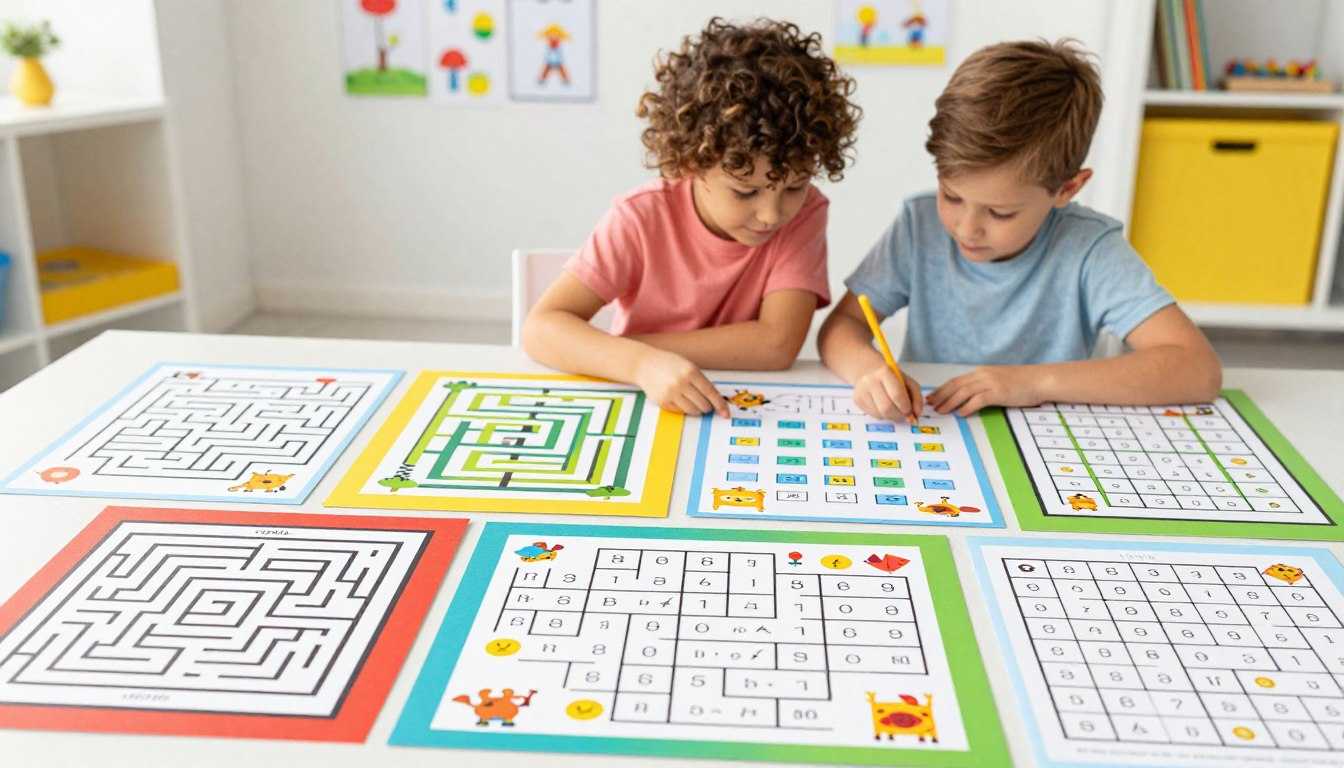
Something happens around age six that parents notice but often cannot name. A child who used to accept “because I said so” starts asking why. A child who used to guess randomly at games starts thinking a move ahead. A child who used to melt down when something did not work starts trying it a different way instead.
This is not stubbornness. It is the beginning of logical thinking — the shift from trial-and-error to deliberate reasoning. And it is exactly the window that well-chosen puzzles are designed to train.
This guide covers what the evidence actually says about logic puzzles for children aged six and seven, which types of puzzles build which skills, how to introduce them without turning a game into a chore, and how to handle the moment — inevitable with every child — when frustration arrives and wants to end the session early.

What the Research Actually Shows
The evidence for puzzles and early cognitive development is strong and consistent across multiple types of studies. A longitudinal study tracking children from age two through four and a half found that early puzzle play was a significant predictor of spatial transformation skills — the ability to mentally rotate and manipulate shapes — and that the quality of parent involvement during puzzle sessions amplified the effect substantially.
For children aged five to six, puzzle-based activities improved visual-motor coordination, pattern recognition, and shape memory, with those benefits translating into stronger early outcomes in both literacy and numeracy. A classroom study integrating puzzles into mathematics lessons for children aged seven to twelve found improved logical reasoning, abstraction, and memory, alongside higher classroom engagement and measurably greater problem-solving confidence.
Research on puzzle frequency matters too. Children who engage with puzzles more than six times a week show significantly stronger spatial reasoning development than peers who puzzle less frequently. That is not a high bar — it means brief, regular engagement beats long occasional sessions, which matches what we know about memory and skill consolidation across almost every domain of child learning.
Why Ages Six and Seven Are a Particularly Good Window
Cognitive development research identifies the period from six to eight as a turning point for executive function — the cluster of mental skills that includes focused attention, planning, working memory, and self-regulation. Before this window, children predominantly learn through exploration and imitation. During it, they begin to hold rules in mind, apply them systematically, and adjust their approach when something is not working — which is exactly what a logic puzzle requires.
This does not mean every six-year-old is ready for the same challenge. The signs that a child is in this window include the ability to sort objects by multiple attributes at once (color and shape, not just one), willingness to follow multi-step games with rules, and some capacity to explain their own thinking when asked. If these behaviors are present, logic puzzles will work. If they are not yet consistent, simpler pattern activities and spatial play are the right starting point.
The Three Categories of Logic Puzzles Worth Using
Visual Pattern Puzzles
Pattern recognition is one of the most trainable cognitive skills at this age, and visual pattern puzzles provide direct practice. The task is simple to explain but genuinely demanding: look at a sequence, figure out the rule, predict what comes next. What makes this valuable is not the answer — it is the process of forming a hypothesis, testing it mentally, and revising when it does not fit.
Pattern puzzles work best when the child is asked to explain their reasoning aloud before checking whether they are right. “What do you notice about the shapes?” produces more cognitive benefit than “what comes next?” because it requires the child to articulate the rule, not just apply it implicitly.
Deductive Reasoning Puzzles
Deductive puzzles give children a set of clues and ask them to work out a conclusion by eliminating what cannot be true. A simple version: “Sam, Mia, and Joe each have a different pet. Sam does not have a dog. Mia does not have a cat. Joe has a fish. What does each person have?” These puzzles teach children to hold multiple pieces of information simultaneously, apply each one systematically, and arrive at a conclusion through elimination rather than guessing.
This skill — reasoning from given information toward a logical conclusion — transfers directly to reading comprehension, early mathematics, and science reasoning. A classroom study on strategy-based games found significant improvements in planning, sequencing, and logical reasoning in children who engaged with these formats regularly.
Spatial and Shape Puzzles
Spatial puzzles — tangrams, shape sorters, block building challenges, and jigsaw puzzles with irregular pieces — build the mental rotation and visuospatial reasoning skills that research consistently links to later geometry ability and STEM performance. High correlations have been found between puzzle mastery and eight distinct visuospatial cognitive abilities, including perception, mental rotation, and working memory.
Jigsaw puzzling in particular taps multiple cognitive abilities simultaneously — including perceptual reasoning, working memory, and processing speed — and has been studied as a potential protective cognitive activity across all age groups. At age six and seven, it also develops fine motor precision and sustained attention in a way that few other quiet activities match.
| Puzzle Type | Primary Skill | Research Outcome | Good Starting Format |
|---|---|---|---|
| Visual pattern | Pattern recognition | Observation and working memory | Printable sequence cards |
| Deductive reasoning | Logical elimination | Planning and critical thinking | Simple clue-based grids |
| Spatial / shape | Mental rotation | Geometry readiness, spatial IQ | Tangrams, jigsaw puzzles |
| Riddles and brain teasers | Lateral thinking | Cognitive flexibility | Verbal riddles at the dinner table |
How to Introduce Puzzles Without Killing the Motivation
The most common mistake parents make with logic puzzles is the same mistake made with reading drills: turning something that should feel like discovery into something that feels like a test. A child who associates puzzles with getting things wrong, with adult impatience, or with having to sit still when they do not want to, will resist puzzles long after the specific unpleasant session is forgotten.
Start Below the Ceiling
Begin with puzzles that are slightly below what you think your child can handle. The first few sessions should feel easy enough to produce genuine success — because that success is what builds the identity of “I am someone who is good at these.” A child who finishes a puzzle with confidence will ask for another one. A child who finishes a puzzle feeling relieved probably will not.
Play Alongside, Not Above
Research on puzzle play consistently identifies parent involvement as a multiplier on outcomes. But the type of involvement matters. Sitting next to your child, thinking aloud, making a wrong guess occasionally, and asking “hmm, what do you notice about this part?” produces better results than supervising from across the room or steering toward the answer. The goal is to model the thinking process, not the solution.
Ask Questions, Not Corrections
When a child gets stuck or goes in a wrong direction, the most productive response is a question that redirects their attention without revealing the answer. “What do you notice about the shapes in this row?” works better than “no, look more carefully.” The first keeps the child doing the cognitive work. The second hands them the navigation without teaching them to navigate.
Useful guiding questions for most logic puzzles include: “What do you know for certain?”, “Can you rule anything out?”, “What would happen if you tried this?”, and “What is the same about these two things?” These prompts teach children to use the systematic elimination and comparison strategies that make logic puzzles soluble.
Making Puzzles Hands-On for Kinesthetic Learners
Children who find it difficult to sit with a paper puzzle often engage far more readily when the same logic problem is presented with physical objects they can move. Counters, colored buttons, building blocks, and dice can all substitute for printed grids — and for many children, the ability to physically rearrange a wrong answer rather than erase it removes a significant source of frustration.
A deductive reasoning puzzle about three characters with three different pets becomes more concrete when represented by three small toys and three object props. A pattern sequence becomes more memorable when built from physical tiles that a child can pick up, examine, and reposition. The logic is identical. The sensory experience of solving it is completely different, and for some children that difference is the entire reason they engage.
| Format | Engagement | Error Correction | Best For |
|---|---|---|---|
| Static paper puzzle | Moderate | Requires erasing | Children who like sitting and writing |
| Physical manipulatives | High | Instant repositioning | Active, tactile learners |
| Verbal riddles | High | No materials needed | Car journeys, mealtimes, any time |
| Movement-based logic | Very high | Embodied trial-and-error | Children with low table-tolerance |
Verbal Riddles: The Logic Puzzle That Needs No Equipment
Riddles are an underrated format for children this age. They require the child to hold a problem in working memory, generate hypotheses, test them against the given information, and arrive at a satisfying conclusion — all within a format that feels playful rather than academic.
Research on preschool-aged children found that regular exposure to verbal riddles boosted comparison, classification, generalisation, and systematisation — all precursors to formal logical reasoning. For six and seven-year-olds, riddles can be slightly more complex: “I have hands but cannot clap. I have a face but no eyes. What am I?” These require genuine lateral thinking and reward children who approach them methodically rather than just guessing.
The best time for riddles is transitions — car journeys, walks, waiting for dinner. They require nothing, work anywhere, and the conversational format makes thinking aloud natural rather than pressured.
Handling Frustration: The Most Important Skill in the Room
Frustration during logic puzzles is not a sign that the puzzle is wrong or that the child is not ready. It is a sign that the cognitive demand is real. The question is not how to eliminate frustration — it is how to stay in the productive zone just above comfort without crossing into the zone where a child shuts down.
The Signs That It Is Time to Pause
Physical signs of genuine frustration — turning away, becoming tearful, pushing the puzzle away, or going silent after repeated effort — are signals to stop the current puzzle, not to push through. Forcing continued engagement after a child has reached their limit does not build resilience. It builds negative associations with the activity.
A brief break followed by a return to an easier version of the same puzzle often resolves the difficulty more effectively than any amount of encouragement in the moment. Returning the next day is also entirely legitimate. The goal is long-term willingness to engage, not completion of any single puzzle.
Growth Mindset Language That Actually Helps
Research on growth mindset distinguishes between praise that builds it and praise that undermines it. “You worked really hard on that” is more useful than “you are so clever” because it attributes success to effort — something the child controls — rather than ability, which feels fixed. When a puzzle goes wrong: “That was a tricky one — what would you try differently next time?” keeps the child in an active, problem-solving orientation rather than a defensive one.
How to Build Logic Puzzles Into a Weekly Routine
- Daily short exposures beat long weekly sessions. Ten minutes of puzzle engagement six days a week produces better results than one sixty-minute session
- Use quiet time strategically. A logic puzzle or jigsaw is a far more cognitively productive quiet-time activity than passive screen time, and children this age can sustain puzzle engagement independently for longer than many parents expect
- Rotate the type. Alternating between visual, deductive, spatial, and verbal formats keeps engagement higher and trains a broader range of skills than repeating the same format
- Verbal riddles at mealtimes. One riddle at dinner requires no preparation, no materials, and uses one of the most cognitively available moments of the day
- Family game nights with strategy games. Games like Connect Four, Battleship, or simple chess variants build forward planning and logical prediction in a social format that reinforces persistence
FAQ
What are the best types of logic puzzles for six and seven-year-olds?
Visual pattern sequences, simple deductive grid puzzles, tangrams, jigsaw puzzles, and verbal riddles all have strong developmental support for this age group. Rotating between them produces broader skill development than sticking to one format.
How often should children do logic puzzles to see benefits?
Research suggests more than six sessions per week produces significantly stronger outcomes than less frequent engagement. Sessions do not need to be long — ten to fifteen minutes of genuine engagement is enough. Frequency matters more than duration.
My child gives up quickly. What should I do?
Start with puzzles that are clearly achievable so that success comes early and feels real. Use guiding questions rather than hints that lead to the answer. Keep sessions short enough to end before frustration peaks. Over several weeks, the threshold for giving up typically rises as confidence builds.
Do printable logic puzzles work as well as physical ones?
They work well for children who are comfortable at a table with a pencil. For children who are more kinesthetic, translating the same puzzle into a format with moveable objects — counters, tiles, toys — often produces significantly more engagement and less frustration.
Can logic puzzles replace screen time?
As a quiet independent activity, puzzles are a strong substitute for passive screen time. They occupy the same window of a child’s day while providing active cognitive engagement instead of passive reception. Physical puzzle materials — jigsaws, tangrams, strategy games — are particularly good for this because they have a natural endpoint and require no parental enforcement of a time limit.
The goal of logic puzzles at age six and seven is not to produce a child who can complete a specific type of puzzle. It is to produce a child who — when they face something they cannot immediately solve — pauses, looks for a pattern, tries something systematic, and stays curious rather than shutting down. That disposition, built in small increments over dozens of short sessions, is more valuable than any single correct answer.

Written by
Nouhaila Benis
Hey! I’m Nouhaila a children’s education teacher with over 5 years of classroom experience across multiple countries. She specialises in early literacy and phonics, with one clear goal: helping every child become a confident, independent reader one word at a time. As a full-time blogger, I share with you my best personal experiences.