

Teaching a five-year-old to write is one of the most tangible skills a parent can support at home — and it is far more manageable than it often appears. The key is sequencing: starting with readiness, building grip and posture before touching letters, and keeping sessions short enough that the child stays curious rather than frustrated.
This guide walks through every stage in order, from assessing whether your child is physically ready to write, through pencil grip, pre-writing strokes, letter formation, spacing, practice routines, and common mistakes. Each section includes practical activities you can use with ordinary household materials, alongside targeted fixes for the problems most parents encounter along the way.
Key Takeaways
- Readiness matters more than age — look for hand strength, hand dominance, and interest in drawing before starting formal letters.
- The tripod grip is the foundation. Fixing grip problems early prevents habits that are hard to undo later.
- Pre-writing strokes — lines, circles, and diagonals — must come before letter formation, not alongside it.
- Uppercase letters are easier to learn first because they sit on the baseline and use simpler strokes.
- Sessions of 10 to 15 minutes are more productive than longer ones for children this age.
- Multi-sensory practice — sand trays, shaving cream, playdough — builds muscle memory faster than paper alone.
Understanding Your Child’s Readiness
Not every five-year-old is ready to write at the same time, and starting too early often creates frustration rather than progress. Readiness is not purely about age — it is about whether the physical and cognitive foundations are in place to make practice worthwhile.
Developmental Milestones to Look For
Before introducing formal handwriting, check whether your child can reliably do the following:
- Hold a crayon or pencil without dropping it after a few strokes
- Show a clear hand preference — consistently reaching with the same hand
- Copy simple shapes: a circle, a square, a cross
- Show interest in drawing or tracing, even informally
- Understand basic directional concepts: up, down, left, right
If several of these are not yet reliable, spending a few weeks on fine motor activities — puzzles, tearing paper, threading beads, using tweezers — will make the eventual transition to writing much smoother.
Pre-Handwriting Skills Assessment
A quick informal assessment can tell you where to start. Ask your child to draw a vertical line from top to bottom, a horizontal line from left to right, and a circle. These three shapes are the building blocks for most letters. If they can do all three with reasonable control, they are ready to progress. If any are unstable, that stroke is where practice should begin.
| Pre-Writing Skill | Letters It Prepares | Simple Practice Activity |
|---|---|---|
| Vertical lines | L, T, I, H, F, E | Draw rain falling, tall buildings, or trees |
| Horizontal lines | E, F, H, T | Draw roads, a horizon, or table edges |
| Circles | O, C, G, Q, D | Trace plates, draw suns or wheels |
| Diagonal lines | A, K, V, W, X, Y, Z | Draw mountains, rooftops, zigzag patterns |
Choosing the Right Tools and Materials
The right materials reduce friction — literally and figuratively. Small hands work differently from adult hands, and standard adult pencils are often too long and too thin for reliable grip control in young children.
Pencils and Grip Aids
Short, triangular pencils are the best starting point for most five-year-olds. Their shape naturally encourages a three-finger grip rather than a fist. If your child is using a standard pencil, a triangular rubber grip aid can achieve a similar effect. Avoid pencil toppers or fidget attachments during practice — they shift attention away from writing.
Paper and Line Spacing
Wide-ruled paper with a visible midline is ideal for early writers. The midline helps children understand tall letters (like b, d, h), short letters (like a, e, o), and descending letters (like g, p, y). Plain paper gives too little structure; standard college-ruled paper has lines that are too close together. If you cannot find the right ruled paper, printing free handwriting guidelines from the internet works just as well.
Alternative Surfaces for Practice
Paper is not the only surface that works. Whiteboards allow children to write large and erase easily, which reduces the pressure associated with “permanent” mistakes. Chalkboards encourage larger arm movements that are good for early practice. Sand trays, shaving cream on a tray, and finger painting all build the same muscle memory as pencil work while feeling like play rather than practice.
Setting Up the Learning Environment
Where and how a child sits has a direct effect on handwriting quality. Poor posture leads to faster fatigue, less control, and habits that are difficult to correct later. Spending five minutes on setup before each session is worth it.
Desk Height and Seating Position
The child’s feet should rest flat on the floor, hips and knees at roughly ninety degrees. The desk surface should sit at or just below elbow height when the child is seated upright. If your table is too high, a firm cushion under the child or a footrest underneath the desk can make a significant difference. The child should be able to rest their forearm on the table without hunching or raising their shoulder.
Paper Angle and Hand Position
The paper should be slightly angled rather than flat in front of the child. Right-handed children benefit from the paper tilted to the left; left-handed children should tilt it to the right. This angle keeps the wrist in a neutral position and reduces the need to hook the hand over the top of the line. The non-writing hand should rest on the paper to keep it stable — many young children forget this, which causes the paper to slide as they write.
Lighting and Workspace
The writing area should be well-lit from above or from the side opposite the writing hand, so the child’s own hand does not cast a shadow on what they are writing. Keep the workspace clear except for the materials currently in use. Extra items on the desk are a reliable source of distraction for five-year-olds.
Mastering Pencil Grip
Pencil grip is the single most important technical skill to establish early. Poor grip creates fatigue, reduces control, and becomes increasingly difficult to correct the longer it goes uncorrected. Most children develop a comfortable grip on their own, but many develop grips that work in the short term while creating problems as writing demands increase.
The Tripod Grip
The tripod grip is the recommended standard for young writers. The pencil rests against the side of the middle finger and is held in place by the thumb and index finger pinching lightly from either side. The remaining two fingers curl gently into the palm. The pencil should angle back toward the writing wrist at roughly 45 degrees.
To introduce this grip, have the child pick up the pencil by pinching the tip with their thumb and index finger, then lower it to the writing surface. The pencil will naturally fall into roughly the right position. Adjust the middle finger into place once the pencil is down.
Correcting Common Grip Problems
Two grip errors are especially common in five-year-olds and worth addressing early:
- The fisted grip: The entire hand wraps around the pencil as if holding a stick. This usually indicates insufficient finger strength or hand control. Address it with finger-strengthening activities — playdough squeezing, using tweezers, water-squirting toys — before returning to pencil work.
- The thumb-wrap grip: The thumb crosses over and lies on top of the index finger, restricting movement. Gently redirect the thumb to rest lightly on the side of the pencil rather than wrapping across it. Triangular grip aids make this correction easier by physically positioning the fingers correctly.
Finger Strength Exercises
Children who struggle with grip control often benefit from targeted finger exercises outside of writing sessions. Rolling playdough into small balls with fingertips, using hole punches, manipulating small pegs or clips, and touching each fingertip to the thumb in sequence all build the isolated finger strength that good grip requires.
Teaching Pre-Writing Strokes
Pre-writing strokes should be practiced before formal letter introduction, not simultaneously. Children who can already produce controlled vertical lines, horizontal lines, circles, and diagonal lines will learn letters significantly faster than those who are still mastering these basic movements at the same time as letter shapes.
Vertical and Horizontal Lines
Start with vertical lines, practiced from top to bottom — the direction used in most letter strokes. Ask your child to draw rain, tall trees, or buildings. Move to horizontal lines practiced from left to right, which establishes the same direction as reading and writing. Drawing roads, horizons, or shelves works well as a framing context that makes the task feel purposeful.
Circles and Curved Lines
Circles are the foundation for the most common letter group — O, C, G, D, Q — and should be practiced in an anticlockwise direction, which matches the formation of most curved letters. Ask the child to draw wheels, plates, suns, or faces. Curved lines (open semicircles and arches) can follow once full circles are reliable.
Diagonal Lines and Zigzags
Diagonal strokes are the trickiest pre-writing pattern for most children because they require controlled movement in a direction that is neither horizontal nor vertical. Drawing mountains, roof shapes, and zigzag borders helps establish the motor pathway. Do not rush this stage — diagonal control directly affects letters like A, K, M, N, V, W, X, Y, and Z.
Step-by-Step Letter Formation
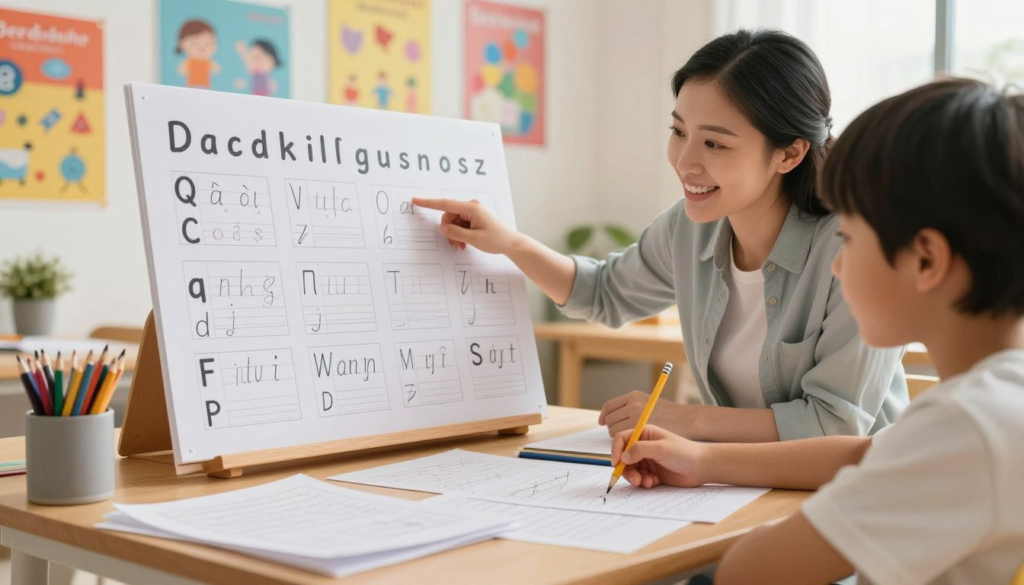
Letter formation should be introduced in a deliberate sequence — not alphabetically, but grouped by the strokes they share. This approach is used by most structured handwriting programs because it lets children apply skills they have already practised to each new letter, rather than treating every letter as a fresh challenge.
Start with Uppercase Letters
Uppercase letters are easier to learn first for two reasons: they all sit on the same baseline without ascenders or descenders to worry about, and they are more visually distinct from one another than their lowercase counterparts. Children are also more motivated by them early on because they can immediately write their name.
Introduce uppercase letters in stroke-family groups rather than A to Z:
- Straight-line letters first: L, T, I, H, E, F — these use only vertical and horizontal strokes already practised
- Curved letters next: C, O, G, Q, D — these use the circular motion already practised
- Combination letters last: B, P, R, A, K, M, N, V, W, X, Y, Z — these combine stroke types and require more coordination
Introducing Lowercase Letters
Once uppercase letters are reasonably reliable, introduce lowercase using the same family grouping. Begin with letters that closely resemble their uppercase counterparts (c/C, o/O, s/S, v/V, w/W, x/X), then move to letters that share strokes with those already known. Save the most commonly reversed letters — b, d, p, q — for when the child has enough letter knowledge to distinguish them from multiple reference points.
| Group | Uppercase | Lowercase | Shared Stroke |
|---|---|---|---|
| Straight-line | L, T, I, H, E, F | l, t, i, h, e, f | Vertical and horizontal lines |
| Curved | C, O, G, Q, D | c, o, g, q, d | Anticlockwise circle or curve |
| Diagonal | A, K, V, W, X, Y, Z | a, k, v, w, x, y, z | Diagonal strokes |
Teaching Directionality
Every letter has a correct starting point and a correct direction of travel. These matter because incorrect directionality becomes a deeply ingrained habit that is very difficult to undo. Use consistent verbal cues when introducing each letter: “Start at the top. Big line down. Jump back to the top. Small line across.” The cue should describe the movement, not just the shape.
A green dot at the starting position of each letter in practice sheets is a simple, effective visual reminder for children who consistently start letters in the wrong place.
Teaching Proper Spacing
Spacing is one of the most commonly overlooked handwriting skills, but it has a significant impact on how legible a child’s writing appears. Children who have not been explicitly taught spacing often run letters together within words and then place words immediately adjacent to each other, making their writing very difficult to decode.
The Finger Space Technique
The simplest and most reliable method for teaching word spacing is the finger space technique. After writing a word, the child places one finger from the non-writing hand on the paper immediately after the last letter, then begins the next word on the other side of the finger. This creates a consistent, tactile reference for “enough space.” Most children can use this reliably after just a few practice sessions.
Letter Spacing Within Words
Letter spacing within a word is harder to teach explicitly and tends to improve naturally as letter formation becomes more automatic. The most helpful strategy is using well-lined paper with clearly visible letter-height guides, which gives children a consistent frame of reference for sizing letters relative to each other. When individual letters vary widely in height or lean, spacing inconsistencies are usually a symptom rather than the root problem.
| Spacing Technique | Best Used For | How It Works |
|---|---|---|
| Finger space | Word spacing | Place one finger between words as a physical spacer |
| Lined paper with midline | Letter height consistency | Visual reference for tall, short, and descending letters |
| Visual spacer card | Word spacing (alternative) | A small card or craft stick placed between words |
Fun Handwriting Activities That Build Real Skills
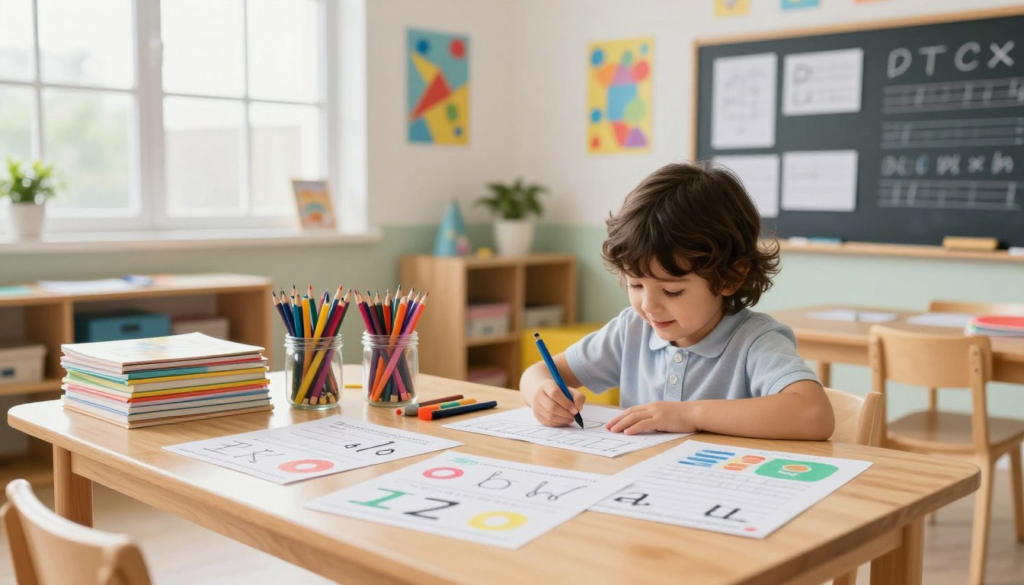
Varied practice is more effective than paper drills alone. Multi-sensory activities build the same muscle memory as pencil work while keeping sessions engaging for children whose enthusiasm for worksheets runs out quickly.
Multi-Sensory Writing Surfaces
- Sand tray: Fill a shallow tray with sand or salt and ask the child to write letters with one finger. The tactile resistance reinforces the motor pattern, and wiping it clean removes the pressure of permanent mistakes.
- Shaving cream: Spray a thin layer on a smooth surface and let the child write with a finger or the eraser end of a pencil. This is especially good for pre-writing strokes and letter formation without pencil pressure.
- Playdough letters: Rolling playdough into ropes and shaping them into letters is excellent for both letter knowledge and hand strength. Ask the child to form a letter, then identify it.
Rainbow Writing
Write a letter in pencil and ask the child to trace over it three times, each time in a different colour. This gives multiple repetitions of the same letter formation without making the task feel repetitive. Coloured markers also provide more tactile variety than a standard pencil, which maintains engagement across longer practice time.
Game-Based Handwriting Practice
- Letter hunt bingo: Create simple bingo cards with letters. Call out a letter by name or by its sound and ask the child to write it in the matching square before marking it off.
- Writing relay: Take turns writing the letters of a word — one letter per person per turn. This makes writing social and slightly competitive without removing the practice element.
- Sky writing: Ask the child to write letters in the air with a straight arm and extended finger before transferring them to paper. This exaggerated movement helps embed directionality into motor memory.
Building an Effective Daily Practice Routine
Consistency matters more than session length. A ten-minute daily practice session will produce better results than a forty-minute session once a week, because handwriting improvement depends on the frequent repetition of motor patterns rather than extended single exposures.
Session Structure
A well-structured session for a five-year-old typically runs 10 to 15 minutes and includes three phases:
- Warm-up (2–3 minutes): Large movement exercises — drawing shapes in the air, rolling playdough, or completing a simple pattern — loosen the hand and establish focus before fine work begins.
- Focused practice (5–8 minutes): Directed letter formation or stroke practice on paper, whiteboard, or an alternative surface. Keep this to one specific skill — one letter family, one spacing concept, or one new letter.
- Cool-down (2 minutes): Free drawing or writing whatever the child wants. This ends the session positively and gives them ownership over the final product.
Sample Weekly Routine
| Day | Warm-Up | Focused Practice | Cool-Down |
|---|---|---|---|
| Monday | Shape drawing in the air | Uppercase straight-line letters (L, T, I, H) | Free drawing |
| Tuesday | Playdough finger rolls | Uppercase curved letters (C, O, G) | Writing their name |
| Wednesday | Sand tray strokes | Review Monday and Tuesday letters | Short word with known letters |
| Thursday | Rainbow line patterns | Lowercase versions of letters already known | Draw and label a picture |
| Friday | Sky writing warm-up | Spacing practice — two-word phrases | Write a message to someone |
Identifying and Correcting Common Mistakes

Most errors in early handwriting are predictable and correctable with targeted strategies. Knowing what to look for makes feedback specific rather than general — “your b is starting in the wrong place” is more actionable for a child than “that does not look right.”
Letter and Number Reversals
Reversals are developmentally normal up to around age seven and do not on their own indicate a learning difficulty. The most commonly reversed letters are b/d, p/q, and n/u. Effective strategies include placing a green dot at the correct starting position, using multi-sensory formation practice (sand tray, sky writing), and teaching each reversed pair separately with a significant gap between them rather than introducing both at the same time.
Inconsistent Letter Size
When letters vary wildly in height, the most useful correction is switching to paper with a visible midline rather than attempting to correct the issue through verbal instruction alone. The midline gives children a concrete reference for the difference between tall letters (b, d, h, k, l, t), short letters (a, c, e, i, m, n, o, r, s, u, v, w, x, z), and descending letters (g, j, p, q, y).
Poor Posture and Incorrect Paper Angle
These are environmental problems, not skill problems. If a child consistently slumps, hooks their wrist, or shifts the paper around while writing, check the desk height, seating position, and paper tilt before introducing any correction to the writing itself. Fixing the environment usually resolves the posture issue without any direct instruction.
Rushing and Loss of Control
Children who rush often do so because they have something to say and are frustrated by the gap between their ideas and their ability to write them down. Rather than asking them to slow down repeatedly, try dictating very short tasks — just one letter, one word, or one short phrase — so there is less content to manage and more attention available for quality. Timed slow-writing challenges (“Can you write this letter as slowly as possible?”) can also be surprisingly effective.
Tracking Progress and Keeping Kids Motivated
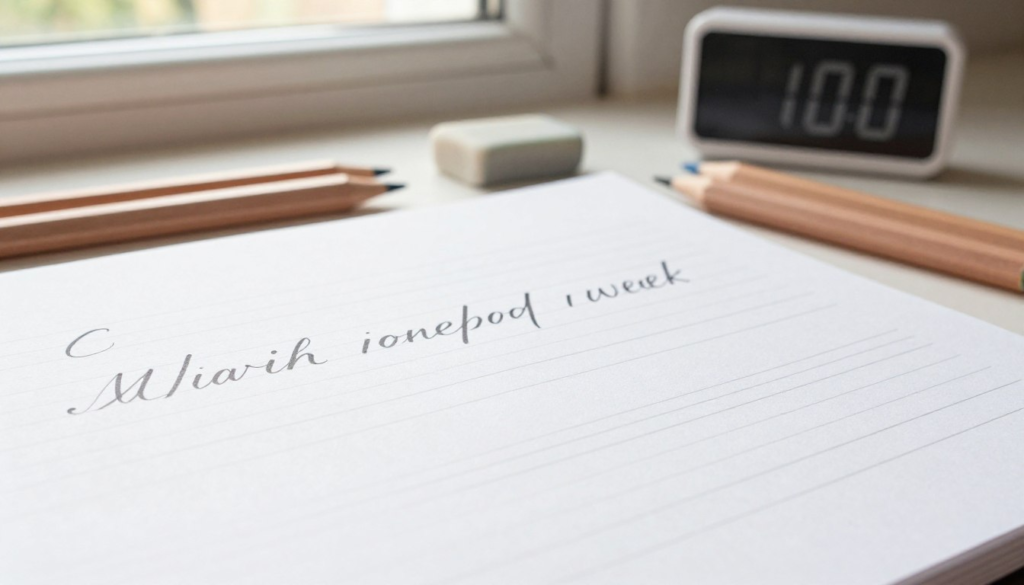
Progress in handwriting is genuinely visible over time, which makes it one of the most rewarding skills to document. Keeping a simple portfolio of dated writing samples — one page saved per week — lets children see their own improvement directly, which is often the most powerful motivator available.
Setting Achievable Goals
Keep goals specific and short-term: “This week we are practising the letter G” or “Today we are working on leaving a finger space between every word.” Vague goals like “write more neatly” are difficult for children to understand or act on. Celebrating the completion of a specific, concrete target is more meaningful than praise for general neatness.
Using Positive Reinforcement
Effective praise focuses on effort and specific improvement rather than natural talent. “I can see you really took your time with those curves today” is more useful than “That’s beautiful.” The first message teaches the child what to repeat; the second teaches them that good handwriting is something you either have or do not have.
When to Seek Additional Support
Most handwriting challenges at age five respond well to patient, structured practice at home. Consider consulting an occupational therapist if your child shows persistent difficulty crossing the body’s midline (reaching with the right hand into the left side of their visual field), avoids all drawing and writing activities despite encouragement, shows an unusual or very painful-looking grip that does not improve with guidance, or struggles significantly more than same-age peers after several months of regular practice.
FAQ
When should I start teaching a 5-year-old to write?
Start when your child can copy basic shapes (circle, cross, square), shows a clear hand preference, and demonstrates interest in drawing or tracing. Age five is a common starting point, but readiness varies. Starting a few months later with a child who is ready will produce better results than starting earlier with a child who is not.
Should I teach print or cursive first?
Teach print first. Print letters are visually simpler, more closely resemble what children see in books, and are what early reading instruction uses. Cursive can be introduced later, typically around age seven or eight when print is already reliable.
How long should each practice session be?
Ten to fifteen minutes per day is sufficient for most five-year-olds. Short daily sessions produce better results than longer infrequent ones. Stop while the child is still engaged rather than waiting until frustration appears.
Is it normal for a 5-year-old to reverse letters?
Yes, letter reversals are developmentally normal up to around age seven. They do not indicate dyslexia or a learning difficulty on their own. Address them with targeted multi-sensory strategies and green-dot starting cues rather than repeated correction.
What is the best pencil for a 5-year-old beginner?
Short, triangular pencils are ideal because their shape naturally encourages the tripod grip. Standard-length round pencils can be made more manageable by adding a triangular rubber grip. Avoid very soft pencils (below 2B) as they smear easily, which frustrates young writers.
What should I do if my child refuses to practise?
Switch the surface or context rather than the demand. A child who refuses to write on paper may happily write in a sand tray, on a whiteboard, or with shaving cream. Embedding the same skill in a different activity — rainbow writing, sky writing, playdough letters — usually resolves refusal without creating conflict around the practice itself.
When should I involve an occupational therapist?
Seek professional advice if your child shows persistent difficulty crossing their body’s midline, avoids all drawing and writing despite encouragement, maintains an unusual or painful-looking grip that does not respond to guidance, or lags significantly behind peers after months of regular practice. An occupational therapist can identify specific underlying challenges and provide targeted strategies.

Written by
Nouhaila Benis
Hey! I’m Nouhaila a children’s education teacher with over 5 years of classroom experience across multiple countries. She specialises in early literacy and phonics, with one clear goal: helping every child become a confident, independent reader one word at a time. As a full-time blogger, I share with you my best personal experiences.