
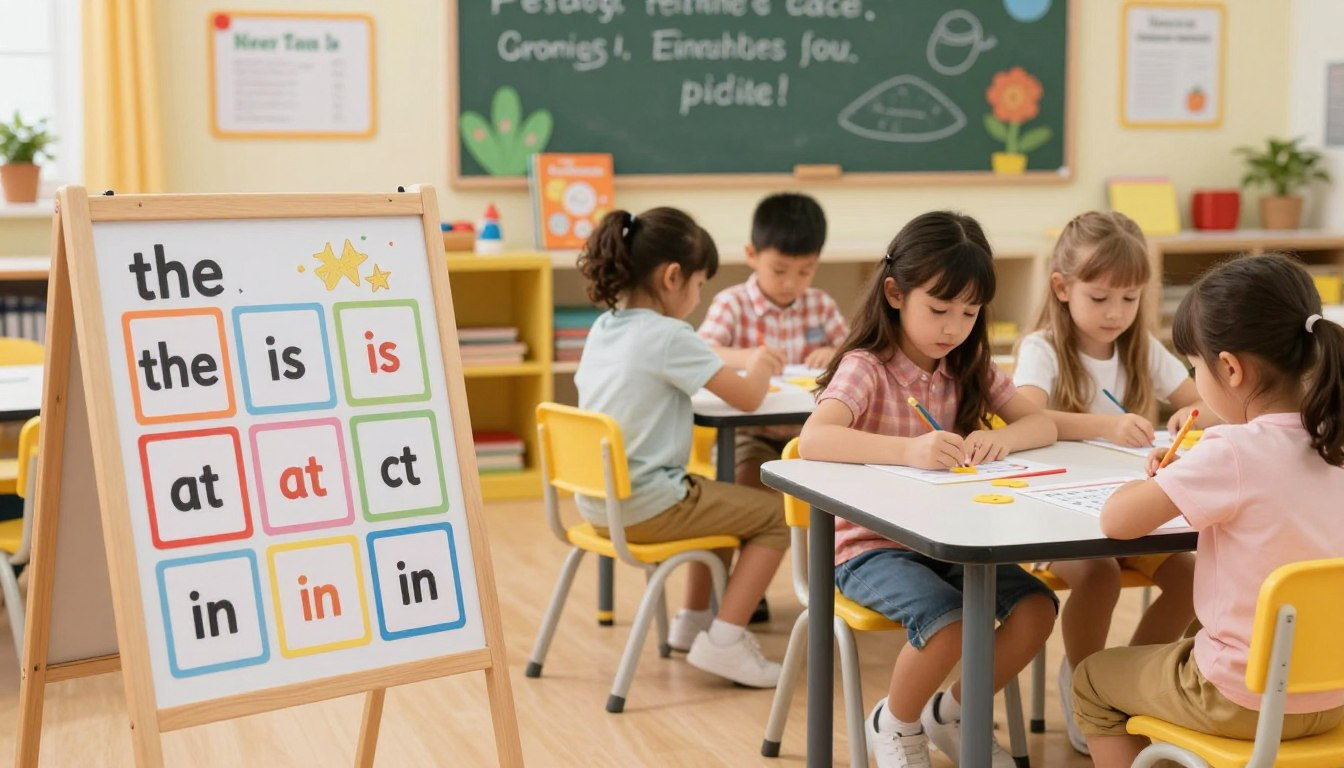
Sight words — also called high-frequency words — are the small, common words that appear in almost every sentence a child will ever read: “the,” “is,” “and,” “you,” “said,” “they.” Many of them cannot be reliably sounded out using standard phonics rules, which means children who do not recognise them automatically must stop and puzzle over them every time they appear. That constant interruption makes reading slow, laborious, and hard to enjoy.
This guide gives you a clear, day-by-day weekly routine for teaching sight words at home, alongside a complete toolkit of activities, a breakdown of the major word lists, and practical troubleshooting for the most common challenges parents encounter. Everything here is designed to take fifteen minutes or less per day and to feel like play rather than drilling.
Key Takeaways
- Sight words are high-frequency words that children need to recognise instantly on sight — many cannot be decoded by phonics rules alone.
- The two most widely used word lists are the Dolch Pre-Primer and Primer lists (92 words combined) and Fry’s First 100 High-Frequency Words — both are valuable, and they overlap significantly.
- Introducing 3–5 new words per week is the recommended pace for most kindergarteners — enough to build vocabulary steadily without causing frustration.
- A structured weekly routine (introduce Monday, practise Tuesday, apply Wednesday, reinforce Thursday, review Friday) produces faster and more durable learning than ad-hoc repetition.
- Multi-sensory activities — writing, tracing, building with physical materials — encode sight words more reliably than flashcard drilling alone.
- Sight word instruction works best when combined with phonics teaching rather than treated as a separate track — the two approaches are complementary, not competing.
Why Sight Words Matter
Research consistently shows that the 100 most common words in English account for roughly half of everything written — across books, websites, signs, and everyday documents. For early readers, that means a child who can recognise the most common 100 words automatically is already halfway to fluent reading before they have ever decoded an unfamiliar word. Every word a child recognises without effort is one less cognitive demand on the limited working memory they have available for understanding what they read.
The speed benefit matters too. Fluency — reading at a pace that sounds natural — depends on automatic word recognition. Children who must laboriously decode common words like “said,” “were,” and “they” every time they appear read so slowly that comprehension suffers even when decoding is accurate. Sight word automaticity removes that bottleneck and frees children to focus on meaning.
| Benefit | What It Means in Practice |
|---|---|
| Improved reading fluency | Automatic recognition of common words keeps reading pace natural, making it easier to understand and enjoy text |
| Better comprehension | Less cognitive effort spent on decoding leaves more mental capacity available for understanding meaning |
| Greater reading confidence | Children who can read the most common words in any book approach new texts with confidence rather than anxiety |
| Faster progress through early readers | Decodable and levelled readers are heavily built around high-frequency words — mastering them unlocks access to a wide range of books |
Understanding the Main Sight Word Lists
Two sight word lists dominate early literacy instruction. Understanding what each contains — and how they differ — helps you choose where to start and how to sequence your child’s learning.
The Dolch Word Lists
Edward William Dolch compiled his word lists in the 1930s by analysing the most frequently occurring words in books written for young children. The full Dolch list contains 220 service words (excluding nouns), divided into five grade levels. The two most relevant for kindergarten are the Pre-Primer list (40 words, typically introduced in pre-K or early kindergarten) and the Primer list (52 words, typically covered in kindergarten and early first grade).
Research suggests that Pre-Primer and Primer Dolch words account for between 50 and 75 percent of the words appearing in early children’s texts — which is why mastering these 92 words has an outsized effect on how quickly a child can begin reading independently.
| Dolch List | Number of Words | When to Introduce | Sample Words |
|---|---|---|---|
| Pre-Primer | 40 | Pre-K or early kindergarten | a, and, the, can, go, I, in, is, it, look, me, my, no, not, see, to, up, we, you |
| Primer | 52 | Mid to late kindergarten | all, am, are, at, be, but, came, do, get, have, he, into, like, said, she, so, they, this, was, with |
Fry’s First 100 High-Frequency Words
Dr. Edward Fry developed his word lists in the 1950s and updated them in the 1980s based on analysis of a much wider range of texts, including material written for adults. Fry’s First 100 words overlap significantly with the Dolch lists but include words drawn from a broader cross-section of written English. Many schools use one list or the other; some use both in parallel. If your child’s school specifies a list, follow that one — if not, either is a solid choice, and the Dolch Pre-Primer list is the most common starting point for kindergarten.
How Many Words Per Week?
The Weekly Sight Word Routine
Three to five new words per week is the pace most early literacy specialists recommend for kindergarteners. That pace produces 90–150 new words across a school year — enough to cover the full Dolch Pre-Primer and Primer lists with room for review and consolidation. Children who are racing ahead can handle five; children who are finding it challenging should stay at two or three without any concern — the goal is solid retention, not speed.
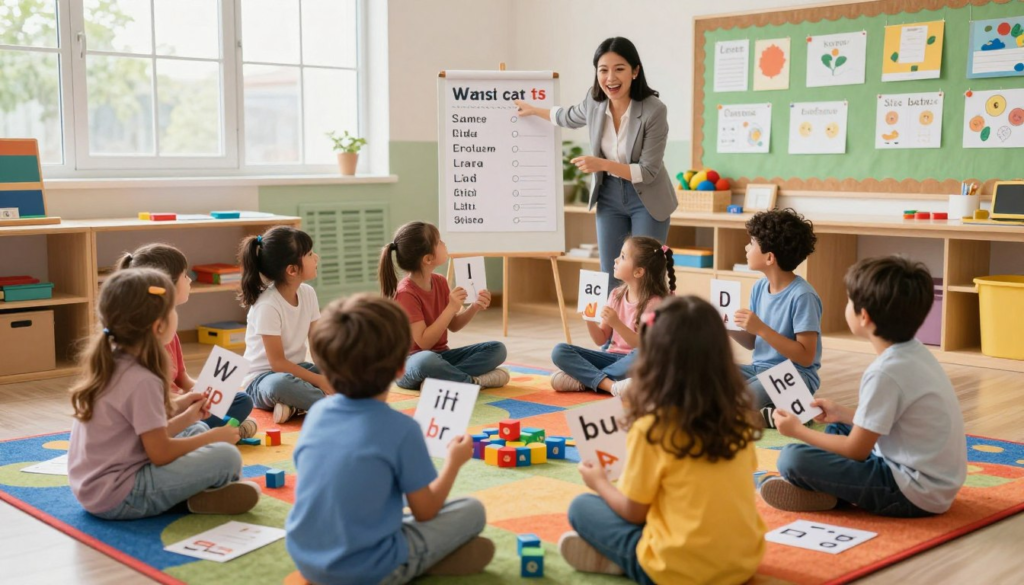
Consistency is the single most important factor in sight word learning. A structured five-day routine removes the decision fatigue of figuring out what to practise each day and ensures that each new word receives the variety of exposures it needs to move from fragile recognition to automatic retrieval. Each day targets a different skill: introduction, recognition, application, reinforcement, and review — so the week naturally builds from first contact to solid mastery.
Monday: Introduction and Multi-Sensory Exploration
Monday is for meeting new words for the first time. Introduce your three to five words for the week by showing each one, saying it clearly, and using it in a sentence. Then move straight into a multi-sensory activity that helps the word stick.
Rainbow writing is one of the most effective introductory activities: write the word in pencil and have your child trace over it repeatedly, each time in a different colour. The repeated tracing builds the motor memory of the word’s shape while the colour change keeps the activity engaging. Alternatives include tracing letters in a shallow tray of sand or salt, stamping letters with foam stamps, or using magnetic letters to build the word on the fridge.
The principle underlying all of these activities is the same: children encode new words more durably when they encounter them through multiple senses simultaneously — seeing the word, saying it aloud, and physically forming it at the same time — than through visual exposure alone.
Tuesday: Recognition Through Flashcard Practice
Tuesday focuses on building speed and automaticity with the new words. The goal is for your child to read each word in under two seconds — fast enough that it will not interrupt the flow of reading when they encounter it in a book.
Timed flashcard drills: Show each flashcard and have your child read the word as quickly as they can. Keep the session short — two to three minutes is sufficient at this age. Track which words come instantly and which still need a moment, so you know where to focus extra practice during the week.
Memory matching games: Write each new word on two cards (or use two copies of your flashcards) and lay them face down in a grid. Take turns flipping two cards at a time, reading both words aloud, and keeping the pair if they match. This game works well because each word is read aloud multiple times across the game, and the matching mechanic creates just enough challenge to maintain engagement.
Wednesday: Reading Words in Context
Wednesday is the bridge between isolated word recognition and real reading. A child who can read “said” on a flashcard but fails to recognise it mid-sentence has not yet fully acquired the word — context practice is what closes that gap.
Simple sentence building: Write or say a sentence that includes one of the week’s words and ask your child to read it. “She said hello to the dog.” Then ask them to make up their own sentence using the word. This simple back-and-forth develops both recognition and the understanding of how the word is actually used.
Decodable reader practice: If your child has levelled or decodable readers that contain the week’s sight words, Wednesday is the ideal day to use them. Ask your child to tap the table every time they spot one of the new words as they read. The active noticing task sharpens attention and confirms that recognition is transferring to connected text.
Thursday: Writing and Hands-On Reinforcement
Thursday shifts the focus from reading words to producing them — which is a more demanding task and one that dramatically accelerates retention. Writing a word from memory requires a child to reconstruct it from their own mental representation rather than simply matching what they see, which deepens encoding.
Playdough letter formation: Ask your child to roll the playdough into letter shapes to spell each word. The tactile, three-dimensional element activates a different learning pathway than pencil-and-paper writing and tends to work particularly well for children who find table-based tasks frustrating.
Sight word journals: A dedicated notebook in which your child writes each week’s words (and draws a small picture to go with each one) creates a cumulative record of their progress and gives them something tangible to look back on. Even a simple cover-write-check exercise — look at the word, cover it, write it from memory, check — is highly effective and takes only a few minutes.
Friday: Review and Celebration
Friday is for consolidation and celebration. Review all the words introduced this week, plus a selection of words from previous weeks — spaced retrieval of older words is essential for keeping them secure as new words are added.
Word wall progress: A word wall — a section of wall or a large sheet of card on which all learned words are displayed — gives your child a visual record of how much they have mastered. Adding this week’s newly secured words to the wall is a concrete, visible achievement that motivates continued effort.
Reward systems: Simple reward structures work well at this age. A sticker chart, a “word collector” jar where a marble is added for each mastered word, or a small treat after a successful review session all signal that the effort of the week was noticed and valued. The reward does not need to be elaborate — the celebration of progress is the point.
The Best Sight Word Activities for Daily Practice
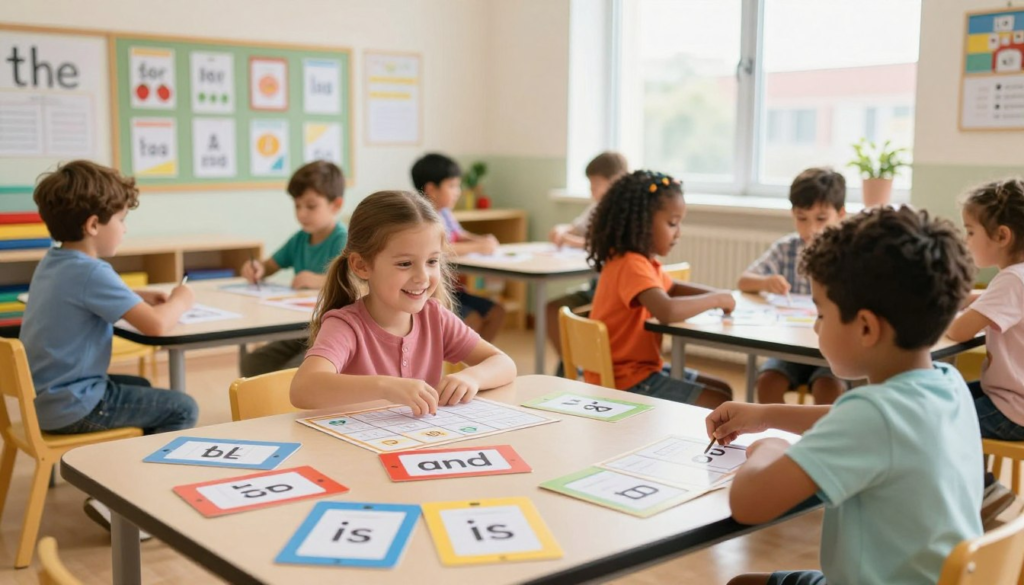
Variety is the most important quality of a successful sight word programme at home. Children who do the same activity every day disengage far more quickly than children whose practice takes a different form each time. The activities below can be used within the weekly structure above or added as short extra practice sessions whenever an opportunity arises.
Sight Word Bingo
Create simple bingo cards with nine or sixteen squares, each containing one sight word (use a mix of this week’s new words and previously learned words for mixed review). Call out words at random — or show flashcards — and have your child cover the word with a counter when they recognise it. The game format produces repeated exposure to each word across the session without feeling like drilling. For multiple children, everyone gets a different card arrangement so the game does not end on the first square.

Written by
Nouhaila Benis
Nouhaila is a children’s education teacher with over 5 years of classroom experience across multiple countries. She specialises in early literacy and phonics, with one clear goal: helping every child become a confident, independent reader — one word at a time.