
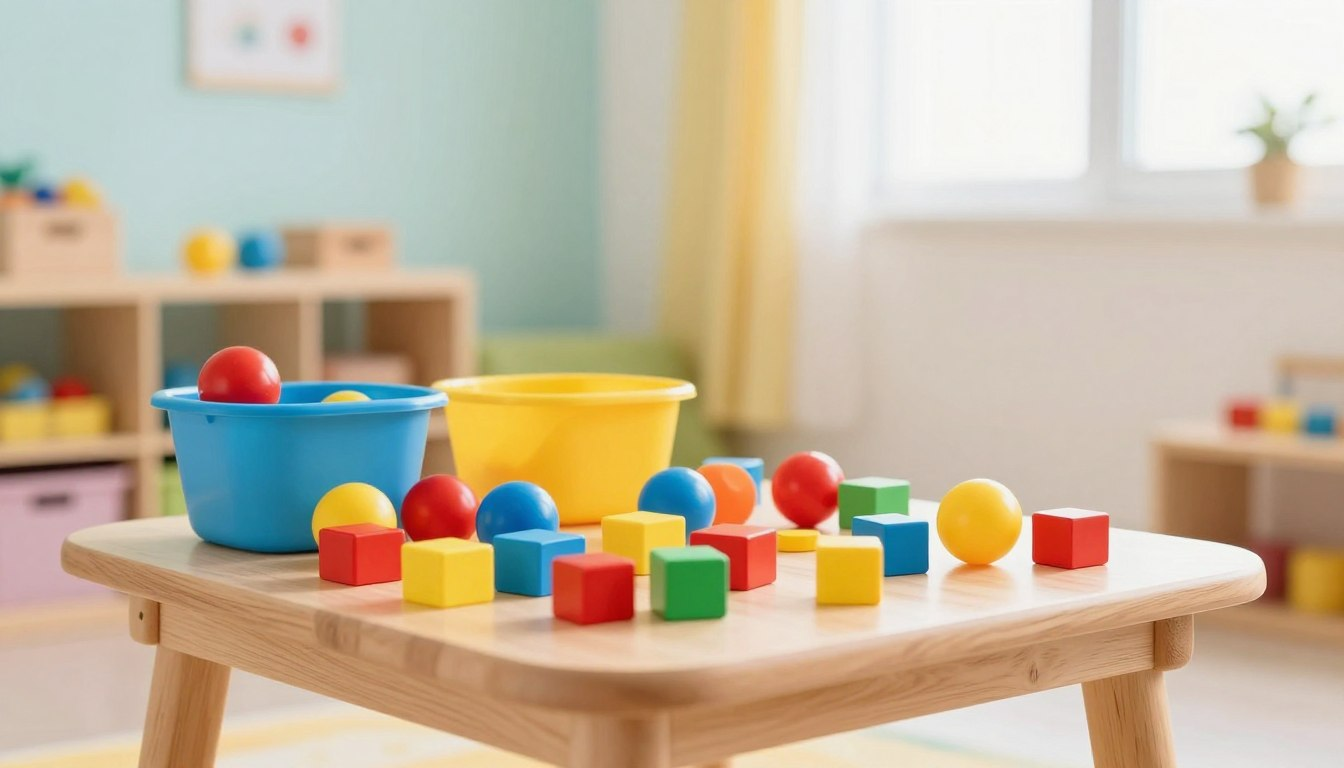
Color sorting is one of the most developmentally rich activities available to toddlers — and one of the easiest to set up with materials you already have at home. What looks like simple play is actually a child practising categorisation, exercising fine motor control, developing sustained attention, and building the foundational cognitive skills that underpin early mathematics and reading.
This guide covers twelve activities spanning three levels of difficulty — simple sorting, sensory play, and fine motor challenges — along with interactive games, practical tips for keeping engagement high, and guidance on recognising when your child is ready to move on to something harder.
Key Takeaways
- Color sorting develops cognitive flexibility, categorisation skills, and sustained attention — all of which are directly linked to school readiness.
- Fine motor activities (clothespins, tweezers, tongs) layer hand strength and pincer grip development on top of the colour learning.
- Most toddlers are ready to begin simple colour sorting activities between 18 months and 2 years old.
- Sensory sorting activities — water beads, rice bins, playdough — are particularly effective for children with short attention spans because tactile engagement extends focus naturally.
- The most common mistakes are introducing too many colours at once and placing too much emphasis on getting the “right” answer — both undermine the exploratory quality of the activity.
- All twelve activities in this guide can be set up with household materials; no specialist toys are required.
Why Color Sorting Matters for Toddler Development
When a toddler picks up a red pompom and places it into a red bowl, they are doing several things simultaneously: perceiving and naming a colour, comparing the object to a category, making a decision, and executing a precise physical movement to complete it. Repeated across dozens of objects in a single session, that sequence builds cognitive flexibility — the ability to hold a rule in mind and apply it consistently — which research identifies as a key predictor of academic performance in the early school years.
The fine motor dimension is equally significant. The pincer grip — the coordination of thumb and forefinger used to pick up small objects — is the same grip required for holding a pencil. Activities that practise this grip in a purposeful, low-pressure context (sorting rather than writing) build the hand strength and control that make early writing far more accessible when children reach it in school.
| Developmental Benefit | What It Looks Like in the Activity | Why It Matters Later |
|---|---|---|
| Cognitive flexibility | Holding a colour category in mind and applying it consistently across many objects | Foundation for classification in maths, sorting in science, and rule-following in reading |
| Fine motor development | Picking up small objects and placing them precisely | Builds the pincer grip needed for pencil control and writing |
| Sustained attention | Completing a full sorting task without redirecting | Prepares children for the focused attention required in classroom settings |
| Vocabulary development | Hearing and using colour names in context during the activity | Colour vocabulary is one of the most tested concepts in early childhood assessments |
| Problem solving | Deciding where an object belongs when the match is ambiguous (e.g., dark red vs. orange) | Develops tolerance for ambiguity and the habit of reasoning through decisions |
When to Start: Recognising Readiness
Most children become ready for simple colour sorting activities somewhere between 18 months and 2 years old, though this varies considerably. The readiness signs to watch for are not about colour knowledge — your child does not need to know any colour names to begin — but about the underlying cognitive and physical capacity to engage with the task.
Signs Your Toddler Is Ready
- They show interest in objects of a particular colour — reaching for, pointing at, or grouping them spontaneously
- They can pick up small objects using their thumb and forefinger (pincer grip) with reasonable control
- They can sustain attention on a single activity for at least two to three minutes
- They show an interest in putting things into containers or matching objects together
How to Pace the Activities
Start with two colours only — red and blue, or yellow and green — using large, easily handled objects. Once your child can sort two colours consistently without prompting, add a third. Progress from large objects (building blocks, fabric scraps) to smaller ones (pompoms, buttons) as fine motor control develops. Activities that feel slightly challenging but achievable — where your child succeeds most of the time but occasionally has to think — are the ones that produce the fastest developmental gains.
Simple Color Sorting Activities to Start With
These three activities require minimal materials, take under five minutes to set up, and are appropriate for children from 18 months onwards. They form the foundation from which all the more complex activities below build.
1. Pompom Sorting with Bowls
Place four or five coloured bowls on a flat surface and mix a large pile of pompoms in matching colours in the centre. Ask your child to put each pompom into the bowl that matches its colour. Start with two colours; add more bowls and colours as confidence grows.
The key upgrade for this activity is adding a tool: give your child kitchen tongs or a clothes peg to pick up the pompoms instead of their fingers. The extra challenge of grasping with a tool significantly increases the fine motor benefit and extends the time children stay engaged because it adds a layer of satisfying difficulty. A small egg cup slotted into the bowl gives them a target to aim for, which further develops hand-eye coordination.
- Materials: Coloured pompoms, matching bowls, optional tongs or clothes pegs
- Age range: 18 months and up
- Skills developed: Colour recognition, fine motor control, sustained attention
2. Building Block Color Towers
Give your child a mixed pile of coloured building blocks and ask them to build a separate tower for each colour — all the red blocks stacked together, all the blue blocks together, and so on. The stacking element adds a spatial and balancing challenge on top of the sorting, and the towers serve as a visible record of the child’s categorisation — they can see the results of their sorting in three dimensions.
For children who find sorting too abstract, building towers first and then labelling what colour each tower is reverses the sequence and can be a useful starting point — the physical building provides the engagement, and the colour conversation happens naturally alongside it.
- Materials: Coloured building blocks (LEGO DUPLO or wooden blocks work well)
- Age range: 18 months and up
- Skills developed: Colour recognition, spatial reasoning, problem solving, fine motor control
3. Rainbow Plate Sorting with Everyday Objects
Place a large paper plate or tray divided into sections (use a marker to draw dividing lines or use a plate with natural sections) in the centre of the table. Walk around the house with your child and collect a handful of small everyday objects — a red crayon, a blue hair tie, a yellow block, a green sock. Then ask your child to place each object in the section that matches its colour.
The collection phase of this activity is as valuable as the sorting phase. Walking around the house looking for colours trains children to notice colour as a property of every object in their environment — which is the generalisation of colour knowledge from play materials to the real world.
- Materials: A tray or paper plate, everyday household objects in different colours
- Age range: 18 months and up
- Skills developed: Colour recognition, categorisation, observation, vocabulary
| Activity | Materials Needed | Primary Skills | Best Age |
|---|---|---|---|
| Pompom Sorting with Bowls | Pompoms, coloured bowls, optional tongs | Colour recognition, fine motor, attention | 18 months+ |
| Building Block Colour Towers | Coloured blocks | Colour recognition, spatial reasoning, motor control | 18 months+ |
| Rainbow Plate Sorting | Tray, everyday household objects | Colour recognition, categorisation, vocabulary | 18 months+ |
Sensory Color Sorting Activities
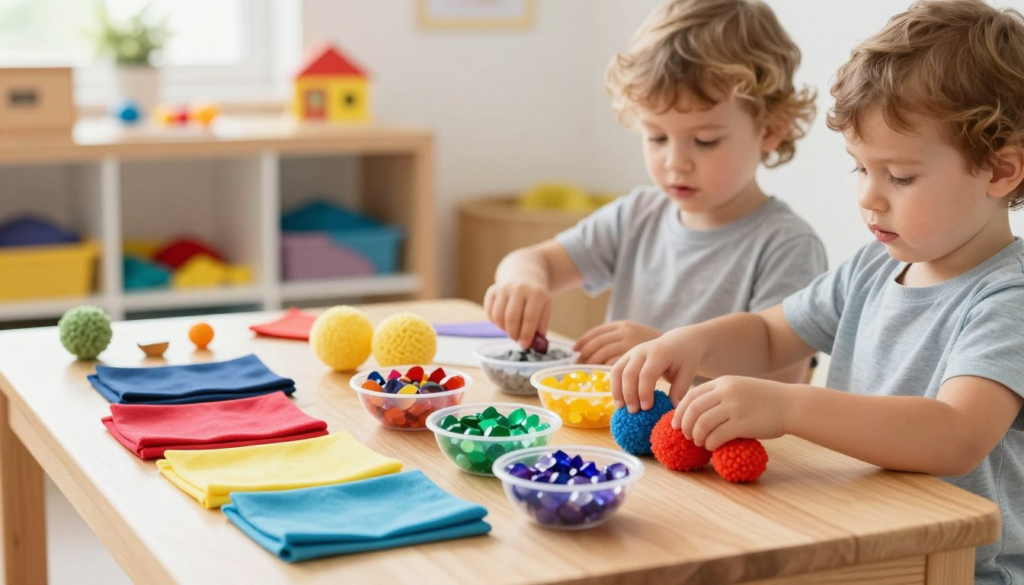
Sensory sorting activities combine tactile exploration with colour recognition, which makes them particularly effective for children who disengage quickly from purely visual tasks. The texture of the material — the squelch of water beads, the graininess of rice, the malleability of playdough — provides continuous sensory input that sustains attention far longer than a plain bowl of objects does. These activities are also highly accessible for children with sensory-seeking tendencies.
4. Water Bead Color Sorting Station
Fill a large shallow container with water and add a mixture of water beads in three or four different colours (water beads are widely available online and expand to approximately 1cm diameter when hydrated). Place a small cup in each colour beside the main container and ask your child to sort the beads by colour. The sensory experience of feeling the smooth, jelly-like beads is highly engaging and provides a strong tactile contrast to the visual colour-matching task.
Important safety note: water beads are a choking hazard and must only be used with direct adult supervision. They should not be used with children who still mouth objects.
- Materials: Water beads (multi-colour pack), large shallow container, small cups for sorting, water
- Age range: 2.5 years and up (with supervision)
- Skills developed: Colour recognition, fine motor control, tactile sensory processing, sustained focus
5. Rice Bin Rainbow Hunt
Fill a large bin or deep tray with uncooked white rice and hide small coloured objects throughout it — beads, buttons, small plastic animals, or blocks. Give your child a spoon or small scoop and ask them to dig through the rice to find the hidden objects, then sort them by colour into separate cups. The hunt element — not knowing where the next object is or what colour it will be — dramatically increases engagement compared to sorting a visible pile, because each discovery feels like a find.
For a more structured version, give your child a colour card before they begin and ask them to find specifically the objects that match that colour — then swap the card for a different colour once they have found all of the first. This version builds colour-directed search behaviour, which is a more sophisticated cognitive task than general sorting.
- Materials: Large bin, uncooked rice, small coloured objects, spoon or scoop, sorting cups
- Age range: 2 years and up
- Skills developed: Colour recognition, fine motor control, problem solving, concentration, sensory processing
6. Playdough Color Matching Challenge
Prepare or purchase playdough in four to six colours. Create a set of colour swatches — simply paint squares on cardstock or cut coloured card — and lay them on the table. Ask your child to roll out a ball, sausage, or flat disc of playdough and place it on the matching colour card. Progress to asking your child to make a specific object (a snake, a ball, a flat disc) in the colour that matches the card you hold up.
The open-ended creative element of playdough is what makes this activity particularly durable — children can engage with it for longer than most sorting activities because there is no single correct outcome. The colour matching gives it structure; the playdough gives it freedom.
- Materials: Playdough in multiple colours, colour swatch cards (painted cardstock or coloured card)
- Age range: 18 months and up
- Skills developed: Colour recognition, fine motor control, creativity, tactile sensory development
Fine Motor Color Sorting Games
These activities are designed specifically to develop the hand strength, precision, and pincer grip that toddlers will need for writing. They are all harder than the simple sorting activities above and are best introduced once a child is comfortable with basic colour sorting — typically from around age 2 to 2.5 onwards.
7. Clothespin Color Matching
Cut a strip of cardstock approximately 30cm long and paint or stick coloured sections along its length — one section for each colour you are practising. Paint or colour-code a set of wooden clothes pegs to match. Ask your child to clip each peg onto the matching colour section of the strip. The squeezing motion required to open a wooden peg is an excellent exercise for the intrinsic muscles of the hand that control pencil grip.
For a harder version, create a wheel by cutting a circle of card and dividing it into coloured segments. Your child clips the matching peg to the outer edge of each segment. This version requires holding the wheel stable with one hand while operating the peg with the other — which develops bilateral hand coordination alongside the colour matching.
- Materials: Wooden clothes pegs, cardstock colour strip or circle, paint or coloured stickers
- Age range: 2 years and up
- Skills developed: Pincer grip, hand strength, colour recognition, bilateral coordination
8. Tweezers and Pompom Sorting
Place a mixed pile of pompoms on one side and a set of coloured cups on the other. Give your child a pair of child-safe tweezers (or salad-serving tongs for younger children) and ask them to use only the tweezers — no fingers — to move each pompom into the correct cup. The constraint of using a tool rather than their hands is what makes this activity a fine motor workout rather than a simple sorting task.
Progress the difficulty by reducing the size of the pompoms (standard to mini) or replacing the tweezers with a more challenging tool (chopsticks for older children). The size reduction is particularly significant — small pompoms require a more controlled, precise grip than standard ones and produce noticeably greater hand muscle fatigue, which signals that the muscles are being strengthened.
- Materials: Pompoms in multiple sizes and colours, child-safe tweezers or tongs, sorting cups
- Age range: 2 years and up
- Skills developed: Precision grip, hand-eye coordination, concentration, colour recognition
9. Color Sorting with Egg Cartons
Paint the inside cups of an egg carton in different colours — two cups per colour for a twelve-cup carton works well. Prepare a set of small objects in matching colours: beads, buttons, small plastic tiles, or painted pebbles. Ask your child to place each object into the cup that matches its colour. The small, defined cup size naturally encourages a careful, precise placement that a wide bowl does not.
Egg carton sorting is an excellent activity for introducing shades and tints once a child is confident with the primary colours. Paint two cups in slightly different shades of blue (sky blue and navy, for example) and see if your child can sort light-blue objects from dark-blue ones — a genuinely challenging discrimination task that develops more sophisticated colour perception.
- Materials: Empty egg carton, paint, small coloured objects (beads, buttons, painted pebbles)
- Age range: 2 years and up
- Skills developed: Precise placement, colour discrimination, categorisation, fine motor control
| Activity | Fine Motor Skill Target | Difficulty Level |
|---|---|---|
| Clothespin Color Matching | Pincer grip and hand strength | Moderate |
| Tweezers and Pompom Sorting | Precision grip and tool control | Moderate to challenging |
| Egg Carton Color Sorting | Precise placement and colour discrimination | Moderate |
Interactive Color Sorting Games
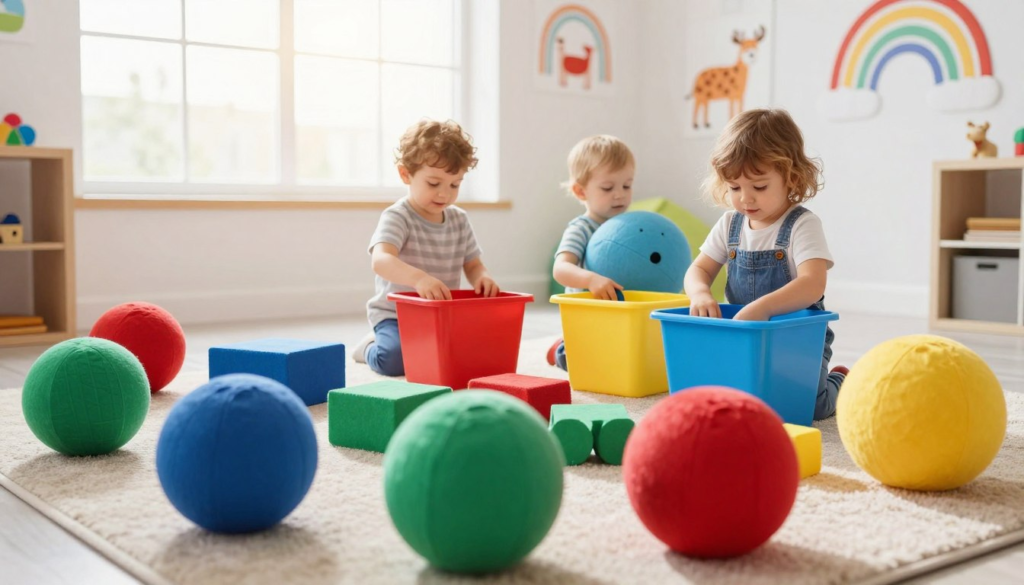
These activities introduce a social or movement dimension to colour sorting, which makes them feel genuinely game-like rather than task-like. They are particularly useful for children who disengage from solo sorting activities but thrive in play with a partner.
10. Color Scavenger Hunt Around the House
Call out a colour and challenge your child to find as many objects of that colour as they can within two minutes, collecting them in a basket. Then sort the collection together and count how many of each colour you found. The movement component — running from room to room — converts what might otherwise be a sedentary activity into physical play, and the time limit creates just enough urgency to maintain focus throughout.
A variation that works well outdoors: give your child a colour card to carry and ask them to find natural objects (leaves, stones, flowers, feathers) that are as close to that colour as possible. Nature does not come in standardised colours, so this version develops a more nuanced, comparative understanding of colour than indoor sorting with uniformly coloured objects does.
- Materials: A basket or bag; no other preparation required
- Age range: 2 years and up
- Skills developed: Colour recognition in natural contexts, physical activity, counting, observation
11. Sorting Color Bears with a Dice Game
Coloured counting bears (widely available from educational suppliers and online) are one of the most versatile manipulatives for early childhood. For this game, create a simple colour die by covering a foam cube with coloured sticker dots — one colour per face. Your child rolls the die and must place one bear of the matching colour into the correct section of a sorting mat. The first player to fill all sections of their mat wins.
The dice mechanism introduces an element of chance that makes the outcome genuinely unpredictable, which is what makes the game feel different from plain sorting. It also naturally introduces turn-taking and the earliest concepts of fair play — all within a colour learning activity.
- Materials: Coloured counting bears, foam colour die (or a numbered die with a colour matching chart), sorting mat or tray
- Age range: 2.5 years and up
- Skills developed: Colour recognition, turn-taking, early numeracy, fine motor control
12. Musical Color Sorting Challenge
Spread coloured sorting mats or paper plates in different colours around the floor. Play music while your child dances or moves around the room. When the music stops, call out a colour and your child must run to stand on the matching mat as quickly as possible. This is the colour-sorting equivalent of musical chairs — it adds physical movement, auditory processing, and quick decision-making to the core colour recognition skill.
A sorting variation: instead of standing on the mat, your child must pick up one object of the called colour from a central pile and run it to the matching mat before the music starts again. This version sustains activity across the full length of the session and ends when all objects have been sorted correctly — giving the game a clear, satisfying endpoint.
- Materials: Coloured mats or paper plates, music player, optional pile of coloured objects
- Age range: 2 years and up
- Skills developed: Colour recognition, physical activity, auditory processing, quick decision-making
“Play is the highest form of research.” — Albert Einstein
Tips for Keeping Activities Engaging
Start with Two Colours Only
The most common reason toddlers disengage from colour sorting is that too many colours are introduced at once. Two clearly contrasting colours — red and blue, or yellow and green — are sufficient for the first several sessions. Adding a third colour only once the first two are sorted automatically, and a fourth only once three are secure, keeps the cognitive demand at the right level: challenging enough to require effort, not so overwhelming that the child gives up.
Connect to Your Child’s Current Interests
A child who is obsessed with dinosaurs will engage far more readily with “sort the dinosaurs by colour” than “sort the pompoms.” Using your child’s current favourite toys, characters, or themes as the sorting objects transforms the same underlying activity into something personally meaningful. Even a child who resists structured activities will often willingly sort their own toys if the framing is right.
Introduce a Timer for Extra Challenge
A visual sand timer (60 or 90 seconds) adds gentle time pressure that increases engagement without creating stress. “Let’s see how many you can sort before the sand runs out” is a more motivating frame than an open-ended sorting task for many toddlers. The timer also naturally limits session length, which prevents the activity from running on until the child’s attention has fully expired — ending while engagement is still high makes the next session easier to start.
Emphasise the Process, Not the Result
Correcting every misplaced object immediately shifts the child’s focus from exploration to performance, which reduces both enjoyment and learning. When a pompom goes in the wrong bowl, the most effective response is curiosity rather than correction: “Hmm, that one’s orange — which bowl should it go in?” This models the thinking process without interrupting the child’s agency. Genuine errors — where your child truly does not know — are better addressed by modelling: sort a few objects yourself while narrating your reasoning, then invite your child to continue.
Common Mistakes to Avoid
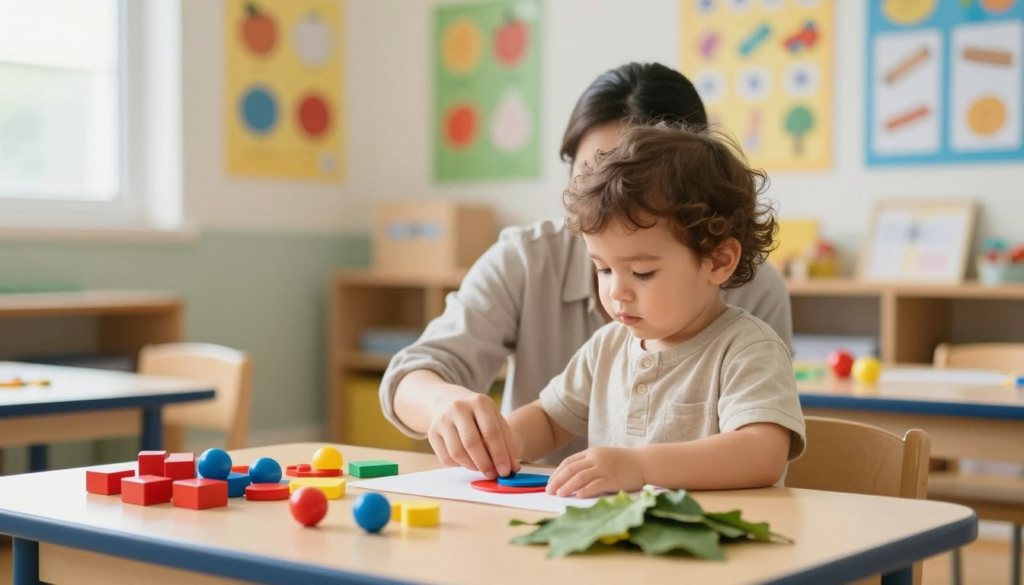
- Introducing too many colours at once. More than three colours in the same session consistently overwhelms toddlers and produces frustrated disengagement rather than learning. Two is ideal for beginners; three is appropriate once two are reliably sorted.
- Treating sorting as a test. Correcting every error immediately, counting mistakes, or measuring how many a child gets right shifts the activity from play to evaluation — which reduces both enjoyment and intrinsic motivation to continue. Exploration and approximation are how toddlers learn; accuracy comes with repetition over time.
- Running sessions too long. Ending an activity when a child is still engaged — before attention starts to wander — leaves them wanting more and makes the next session easier to initiate. Ending after the child has already disengaged trains them to associate the activity with boredom.
- Using the same activity every time. Rotating between the twelve activities in this guide — or varying the materials used in the same activity — maintains novelty and ensures different developmental skills are exercised across the week.
- Skipping fine motor tools. Giving a child their fingers when tools are available removes the most significant developmental benefit of sorting activities. Even if a child finds tongs or tweezers difficult at first, the challenge of the tool is precisely where the fine motor development happens.
How to Track Your Child’s Progress
Progress in colour sorting is visible and tangible, which makes it one of the easier developmental skills to monitor informally at home. The indicators to watch for are not how many colours a child can name (naming lags behind recognition by several months in most children) but how they sort — and specifically, how quickly, accurately, and independently they do it.
A child who needed frequent prompts to complete a two-colour sort a month ago and now does a three-colour sort independently without prompting has made significant progress, even if they cannot reliably name all three colours yet. Track progress by noting which activities your child can complete independently versus which still require scaffolding, and use that observation to choose the right next challenge rather than the right next colour name.
The natural progression across the activities in this guide — from simple sorting to sensory play to fine motor challenges to interactive games — provides a ready-made framework: when your child is completing activities in the current level with ease and apparent boredom, it is time to introduce the next level up.
FAQ
Why are colour sorting activities considered important for preschool readiness?
Colour sorting develops categorisation — the ability to group objects by shared properties — which is a foundational skill in both early mathematics (grouping and counting like objects) and science (classifying and comparing). Children who arrive at school with strong categorisation skills adapt to pattern-recognition and sorting tasks far more quickly than those without this background. Beyond the specific skill, the sustained attention required to complete a full sorting activity is itself a form of school readiness preparation.
My toddler is 2 years old and shows no interest in colour sorting — should I be concerned?
Not at all. Interest in colour sorting typically emerges between 18 months and 3 years, and the variation within this range is completely normal. If your child shows no interest in structured sorting, try embedding colour into play they already enjoy — sorting toy cars by colour, sorting food items in a play kitchen, or grouping building blocks by colour while building together. The activity does not need to look like sorting to produce the same developmental benefits.
How do sensory sorting activities help children with short attention spans?
Sensory materials — water beads, rice, playdough, sand — provide continuous tactile stimulation that engages the nervous system independently of the cognitive sorting task. A child whose attention would wander after two minutes of plain pompom sorting may sustain focus for ten minutes in a rice bin, because the texture of the rice provides ongoing sensory input that keeps the sensory system engaged even during the cognitive pauses between finds. This is not a workaround for short attention spans — it is using the natural mechanism by which sensory play extends concentration.
When should I introduce shades and tints beyond the primary colours?
Once a child can reliably sort the six basic colours (red, blue, yellow, green, orange, purple) independently, introducing shades is an appropriate next challenge — typically around age 3 to 3.5. Start with obvious contrasts (light blue versus dark blue) before moving to subtler distinctions (teal versus turquoise). The egg carton activity in this guide is particularly well-suited to shade discrimination because the small, divided cups naturally focus a child’s attention on the precise colour of each object.
Do colour sorting activities help with language development?
Yes, significantly. During colour sorting activities, children hear colour words used repeatedly in meaningful context — “the red pompom goes in the red bowl” — which is the most effective form of vocabulary acquisition for young children. The connection between the word and a direct perceptual experience (seeing the colour while hearing its name) is precisely what makes incidental vocabulary learning during play more effective than flashcard-based colour teaching. Children who do regular colour sorting activities typically have larger, more confident colour vocabularies than those taught colour names through naming drills alone.
What brands offer good sorting toys for home use?
Learning Resources produce the widely used coloured counting bears, which are among the most versatile sorting manipulatives available. Melissa & Doug offer several wooden sorting sets that are durable and well-made. LEGO DUPLO blocks are excellent for colour tower building because they are large enough for younger toddlers to handle confidently. That said, none of the twelve activities in this guide require any specialist product — pompoms, egg cartons, rice, and clothespins are as effective as purpose-made sorting toys and considerably cheaper.

Written by
Nouhaila Benis
Hey! I’m Nouhaila a children’s education teacher with over 5 years of classroom experience across multiple countries. She specialises in early literacy and phonics, with one clear goal: helping every child become a confident, independent reader one word at a time. As a full-time blogger, I share with you my best personal experiences.