

The moment a child sounds out a word they have never seen before — and hears it snap into something they recognise — is one of the most important milestones in early literacy. CVC words make that moment possible. Built on a simple Consonant-Vowel-Consonant pattern, words like “cat,” “bed,” “sit,” “hot,” and “run” give kindergarteners their first real experience of decoding: turning letters into sounds and sounds into meaning entirely on their own.
This guide walks you through everything you need: what CVC words are and why they matter, a comprehensive word list sorted by vowel sound, a structured four-week daily practice plan, activities for different learning styles, and clear strategies for the challenges children most commonly face when learning to blend.
What You Will Find in This Guide
- CVC word foundations: what the pattern is, why it comes first in phonics, and what prerequisite skills children need before CVC instruction begins
- Complete word lists by vowel sound: Short A, E, I, O, and U — organised into word families for maximum teaching efficiency
- A 4-week daily practice plan: structured day-by-day, starting with Short A and building through mixed-vowel mastery
- Activities for every learning style: hands-on manipulatives, movement games, writing exercises, and digital tools
- Teaching strategies: sound-by-sound blending, continuous blending, word families, and targeted fixes for the most common difficulties
- Readiness indicators: how to know when a child is ready to progress beyond CVC words to more complex phonics patterns
Why CVC Words Come First in Phonics Instruction
CVC stands for Consonant-Vowel-Consonant. Every CVC word is exactly three letters long, follows a predictable structure, and uses a short vowel sound — the crisp, unstretched form of each vowel. “Cat” is /k/ /a/ /t/. “Bed” is /b/ /e/ /d/. “Sit” is /s/ /i/ /t/. “Hot” is /h/ /o/ /t/. “Sun” is /s/ /u/ /n/. Every word in this category is phonetically transparent: the letters say exactly what they sound like, with no silent letters, no vowel teams, and no spelling exceptions to navigate.
This transparency is precisely why CVC words are taught first. A child who knows the sounds individual letters make and who can blend three sounds together can decode any CVC word they encounter — including words they have never seen written down before. That generalisation from known examples to novel words is the definition of genuine decoding, and it is the skill that separates a child who is reading from a child who is memorising. CVC words are where real reading begins.
Prerequisites Before Starting CVC Instruction
Two skills need to be in place before CVC instruction will be productive. The first is basic letter-sound knowledge: a child needs to know, at minimum, the sounds made by the most common consonants and the five short vowels. The second is phonemic awareness at the level of segmentation: a child should be able to hear that “cat” is three separate sounds, not just a single unit of sound. Children who lack these prerequisites tend to guess at CVC words rather than decode them — which reinforces ineffective habits and makes the blending instruction harder to establish later.
Most kindergarten programmes introduce CVC words in the first months of the school year, after an initial block of alphabet and phonemic awareness work. The exact timing varies by curriculum and by child, but the prerequisite check is more important than any calendar date: readiness matters more than schedule.
The Confidence Dividend
Beyond the technical skill of decoding, CVC mastery produces something equally important: a child’s first direct experience of their own reading capability. When a child blends three sounds, hears a word they know, and recognises that they have just read something entirely independently, their relationship to reading changes. They stop experiencing it as a performance that must be memorised and start experiencing it as a system they can operate. This shift in self-perception — from passive recipient of words to active decoder of text — is the foundation of reading motivation, and it begins with CVC words.
Complete CVC Words List by Vowel Sound
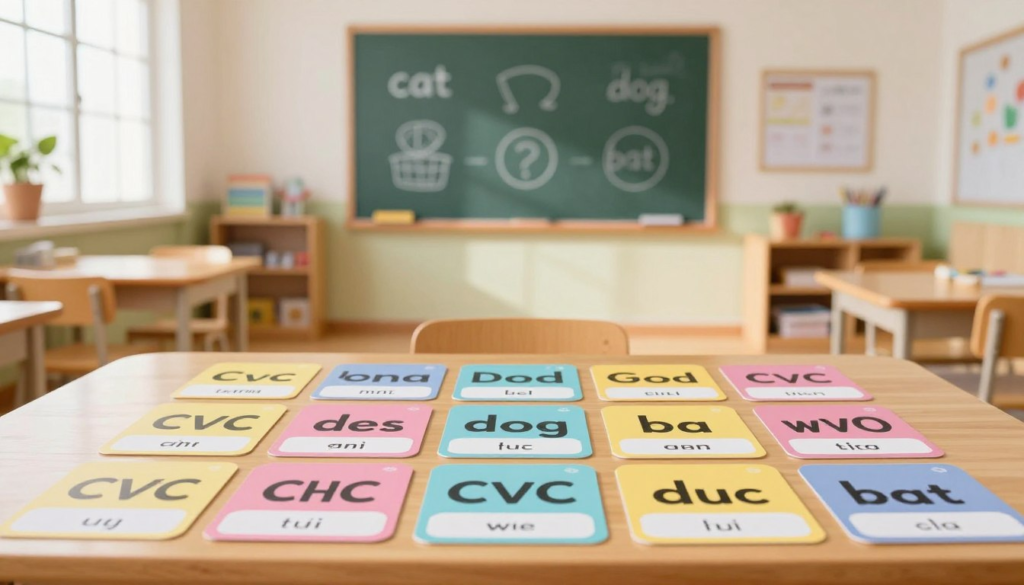
The most effective way to organise CVC word instruction is by vowel sound. Grouping all short A words together — then short E, then short I, and so on — allows children to work with one vowel pattern at a time. This focus reduces cognitive load and builds mastery of each vowel group before new complexity is layered on top. Within each vowel group, the words below are further sorted into word families: groups of words that share the same vowel-and-ending combination (the rime), differing only in their initial consonant (the onset). Teaching word families makes each new word in a family dramatically easier to learn than the previous one, because children are changing only one element at a time.
Short A CVC Words
Short A (as in “cat”) is the standard starting point for CVC instruction. The sound is phonetically clear, and the short A word families are among the largest in English — which means children can practise extensively within a single vowel sound before needing to move on.
| Word Family | Words |
|---|---|
| -at | cat, bat, hat, mat, rat, sat, fat, pat, vat |
| -an | can, fan, man, pan, ran, van, ban, tan |
| -ap | cap, map, nap, tap, gap, lap, rap, sap |
| -ad | bad, dad, had, lad, mad, sad |
| -ag | bag, rag, tag, wag, nag, sag |
| -am | ham, jam, ram, yam, dam |
Short E CVC Words
Short E (as in “bed”) is sometimes harder for children to isolate because it is a mid-front vowel with less acoustic distinctiveness than short A or short O. When introducing short E, contrast it explicitly with short A — “bat” versus “bet,” “map” versus “mep” — so children hear the difference clearly before working with short E words independently.
| Word Family | Words |
|---|---|
| -ed | bed, red, fed, led, wed |
| -et | bet, get, jet, met, net, pet, set, vet, wet |
| -en | den, hen, men, pen, ten |
| -eg | beg, leg, peg, keg |
| -eb | web, deb |
Short I CVC Words
Short I (as in “sit”) appears in a large number of common, useful words and is worth investing significant practice time in. The most common confusion at this stage is between short E and short I — “bed” and “bid,” “pen” and “pin” — so once both vowels have been introduced, include regular mixed E/I sorting activities before introducing the next vowel group.
| Word Family | Words |
|---|---|
| -it | bit, fit, hit, kit, lit, pit, sit, wit |
| -in | bin, din, fin, kin, pin, sin, tin, win |
| -ig | big, dig, fig, jig, pig, rig, wig |
| -id | bid, did, hid, kid, lid, rid |
| -ip | dip, hip, lip, nip, rip, sip, tip, zip |
Short O CVC Words
Short O (as in “dog”) is phonetically distinctive — its round, open quality makes it one of the easier vowel sounds for children to identify and remember. The -og and -ot families are particularly rich and include several words children already know well from spoken language.
| Word Family | Words |
|---|---|
| -og | bog, cog, dog, fog, hog, jog, log |
| -ot | cot, dot, got, hot, lot, not, pot, rot |
| -op | cop, hop, mop, pop, top, bop |
| -ob | bob, cob, job, mob, rob |
| -od | cod, god, nod, pod, rod |
Short U CVC Words
Short U (as in “sun”) is typically taught last. In some accents it can sound similar to short O, and the distinction between the two sounds is worth addressing explicitly when introducing this group. Use anchor words children know well — “sun,” “run,” “bug,” “cut” — to establish the sound before moving through the full word families.
| Word Family | Words |
|---|---|
| -un | bun, fun, gun, nun, pun, run, sun |
| -ut | but, cut, gut, hut, jut, nut, rut |
| -ug | bug, dug, hug, jug, lug, mug, pug, rug, tug |
| -ud | bud, dud, mud, stud |
| -up | cup, pup, sup |
4-Week Daily Practice Plan

Consistent, structured daily practice produces faster and more durable CVC learning than unplanned practice does. The plan below is designed for ten to fifteen minutes per day — an amount that fits comfortably within a kindergarten schedule and sustains attention throughout. Each week introduces one or two new vowel groups, maintains daily review of previously introduced material, and ends with an activity that requires children to work across word families without vowel-group cues.
Week 1: Short A Words
Devote the first week entirely to Short A. A full week on one vowel group gives children enough repetition to begin reading short A words fluently, and fluency at this stage — rather than effortful sounding-out — is what makes adding new vowel sounds manageable in subsequent weeks.
| Day | Activity | Focus Words |
|---|---|---|
| Monday | Introduce the CVC pattern; model continuous blending aloud with cat, hat, mat; children echo each blend | cat, hat, mat |
| Tuesday | Flashcard reading — show word, child reads aloud; match word cards to picture cards | bat, sat, fat, pat |
| Wednesday | Word family building with magnetic letters or tiles — build -at words, then switch onset letters to make new words | rat, van, fan, can, ran |
| Thursday | Dictation writing; read simple Short A sentences aloud (“A fat cat sat on a mat.”) | cat, hat, sat, mat, bat |
| Friday | Mixed Short A review — can the child read all words without hesitation? Note any that still require sounding-out for next week’s warm-up | All Short A words from the week |
Week 2: Short E and Short I Words
Week 2 introduces two new vowel sounds. Alternate the focus day by day — Monday and Tuesday on Short E, Wednesday and Thursday on Short I — so neither vowel receives too little practice. On Friday, introduce a direct Short E versus Short I contrast activity. This is the most important session of the week because it targets the most common vowel confusion children encounter at this stage.
- Short E focus words: bed, red, pet, met, net, pen, hen, ten, wet, get
- Short I focus words: sit, hit, bit, pin, win, big, dig, lip, zip, lid
- Friday contrast activity: Sort a shuffled pile of Short E and Short I word cards into two labelled groups; read each word aloud before sorting
Week 3: Short O and Short U Words
Week 3 follows the same two-vowel structure. Short O is introduced first (Monday and Tuesday), Short U second (Wednesday and Thursday), with a mixed O/U contrast on Friday. By the end of Week 3, children will have been introduced to all five short vowel sounds — a milestone worth marking. A brief celebration and a whole-class or parent-facing communication about this achievement reinforces the sense of progress and motivates continued effort in Week 4.
- Short O focus words: dog, log, hot, pot, hop, top, not, fog, job, cop
- Short U focus words: sun, run, fun, cut, nut, bug, hug, mug, mud, cup
- Friday review: Mixed Short O and Short U sorting; brief whole-group review of all five vowel sounds using anchor words (cat, bed, sit, dog, sun)
Week 4: Mixed Review and Mastery
Week 4 introduces no new words. The entire week is spent consolidating all five vowel groups through mixed-vowel activities — where children must identify the vowel sound and decode the word without any grouping cues. This is the hardest and most important skill of the four-week sequence, because it is exactly what children face in continuous reading text. By Friday, children who can read a mixed-vowel CVC list fluently and without hesitation are genuinely ready to progress to more complex phonics patterns.
- Monday: Five-group sorting — sort thirty word cards (six per vowel) into the correct vowel-sound pile
- Tuesday: CVC word bingo with a fully mixed card — five vowel sounds, nine words per card
- Wednesday: Read a paragraph composed entirely of CVC words in simple sentences (“The big red hen sat on a log. The fat cat got the bug. The dog ran in the mud.”)
- Thursday: Word chain challenge — change one sound at a time to make a new word: cat → cot → got → gut → but → bus → bud → mud → mad → mat
- Friday: Individual oral reading assessment of a twenty-five-word mixed CVC list; celebrate completion of the four-week programme
CVC Word Activities for Every Learning Style
Rotating the activity format is as important as rotating the vocabulary. A child who does flashcard practice every single day will disengage within a week, regardless of how motivating the initial sessions were. The activities below are organised by learning modality and can be mixed into the weekly plan above to keep sessions varied, engaging, and effective across a wide range of learner profiles.
Hands-On Manipulative Activities
Magnetic letter building is one of the most effective CVC activities because it makes the abstract structure of a word physically tangible. Place three letters on a magnetic surface and ask your child to arrange and rearrange them to make as many real words as possible. The physical act of moving letters reinforces the understanding that words are assembled from interchangeable parts — a conceptual insight that is foundational to decoding.
Playdough word mats combine literacy practice with fine motor development. Write target words in large print on card stock and ask children to roll and position playdough letters to spell each word on top of the printed version. The tactile element of forming letters in playdough builds word memory more durably than tracing or copying alone, particularly for kinaesthetic learners.
Self-checking picture-word cards — the word on one side, a photograph or clear illustration of the object on the other — allow children to practise reading independently with immediate feedback. A child reads the word, attempts it, then flips the card to check. The self-checking mechanism is important: it builds the habit of self-monitoring that underpins independent reading, and it allows practice to happen without an adult needing to be present at all times.
Movement-Based Learning
CVC Bingo produces substantial repetition of target words without feeling repetitive because the game format creates genuine engagement. Create bingo cards with nine squares, each containing a CVC word from the current week’s vowel group. Call words aloud or hold up picture cards. The game works with two players or a whole group, cards can be reused with counters rather than permanent marks, and the format is easily adapted to mixed-vowel review by adding words from earlier weeks.
Word hopscotch takes CVC practice outdoors. Write target words on chalk squares in a hopscotch layout on the pavement. Call a word and ask your child to jump to it. An indoor version: tape word cards to the floor and call words for children to step on. The physical movement between cards builds the word-to-visual connection in a way that seated activities alone do not, and the game element sustains motivation through the repetition that fluency requires.
Flip-it reading strips make word families physically visible. Write the rime of a word family (“-at”) on a strip of card and attach a series of initial consonant cards that flip to reveal new words: c-at, b-at, h-at, m-at, r-at, s-at. The flipping mechanism demonstrates the concept of onset and rime in a directly observable way, and children can operate the strips independently once the activity has been modelled.
Writing and Drawing Exercises
Writing CVC words from memory is more cognitively demanding than reading them, and this higher demand accelerates retention. The most effective writing exercise is cover-write-check: look at the word, cover it, write it from memory without looking, then uncover and verify. This can be done in a notebook, on a small whiteboard, or on paper. Three rounds of cover-write-check on a single word produce stronger retention than ten repetitions of tracing or copying with the word visible throughout.
Drawing the object a word represents and labelling the drawing connects written form to meaning — which is, ultimately, what all phonics instruction is in service of. The drawing is not a reward or a diversion from literacy work; it is the meaning anchor that transforms a letter sequence into a real word the child will recognise, remember, and use in reading.
Digital Tools and Printable Resources
Starfall, ABCya, and Phonics Bloom all offer CVC-specific interactive activities with immediate feedback, making them well-suited to independent practice sessions. Their primary limitation is that they develop reading recognition but not writing or fine motor skills — so they work best as a supplement to the physical and writing-based activities above, rather than as the primary practice mode.
Printable worksheets are most effective when they combine multiple task types on a single page: a missing-letter completion task (c_t), a tracing task, and a use-in-sentence task. Single-task worksheets — ten repetitions of tracing the same word, for example — generate much weaker retention than worksheets that require children to engage with the same word in different ways. When selecting or creating worksheet resources, prioritise variety of task type over quantity of repetition.
Teaching Strategies That Work
Sound-by-Sound Blending
Sound-by-sound blending is the core decoding technique for CVC words. Point to the first letter, say its sound; point to the second letter, say its sound; point to the third letter, say its sound; then say all three together quickly. Model this sequence repeatedly and explicitly before expecting children to attempt it independently — many children who appear not to understand blending simply have not seen enough clear demonstrations. Ten to fifteen teacher-modelled examples, with the child echoing each blend, is a reasonable minimum before asking children to blend without support.
Continuous Blending for Children Who Struggle
For children who can identify individual sounds correctly but cannot synthesise them into a word, continuous blending removes the gap between sounds that makes synthesis difficult. Instead of “/k/” pause “/a/” pause “/t/” — which requires holding three discrete sounds in working memory and then merging them — continuous blending stretches the sounds together without breaks: “kkkaaattt.” Speed up gradually: “kaat” — then normal speed: “cat.” The absence of pauses makes the synthesis happen automatically, and most children who struggle with standard blending can read CVC words successfully within a few sessions of continuous blending practice.
Word Families
Teaching through word families means that once a child can read “cat,” they can read “bat,” “hat,” “mat,” “rat,” and “sat” with minimal additional effort — because only the onset (the initial consonant) changes. The rime (-at) remains constant, and once it is known it can be reused across every word in the family. This transferability is the key instructional advantage of the word-family approach: it reduces the learning cost of each new word and makes the pattern of how changing one sound produces a new word directly visible.
Fixing the Most Common Problems
Child can say each sound but cannot produce the word: Switch to continuous blending. Use a physical sliding gesture — a finger that moves continuously from the first letter to the last as the sounds are stretched — to connect the physical motion of blending to the visual sequence of letters.
Child confuses short E and short I: Focus on mouth position — short E is wider and more open; short I is tighter and higher. Use minimal pairs in sorting tasks (“bed”/”bid,” “met”/”mit,” “pen”/”pin”) so children practise distinguishing the sounds directly, in context. Avoid introducing both vowels in the same session until one is secure.
Child reads the first letter correctly but guesses the rest: This is initial-letter cueing — a habitual shortcut that bypasses phonics and must be corrected before it becomes entrenched. Cover the last two letters and ask the child to read only the first sound; then uncover one letter at a time so each letter must be processed individually. Removing picture cues from practice materials also helps, because pictures provide context clues that allow children to guess without decoding.
Child reads CVC words in isolation but misses them in sentences: This is a context-transition issue rather than a decoding problem. The solution is more practice in connected text — specifically, text that is densely populated with the target words so that children encounter the same words repeatedly in a reading context. Write simple sentences that include five or six of the week’s focus words: “The big red hen ran to the wet log” gives a child six CVC word encounters in a single sentence.
When to Move Beyond CVC Words
The readiness indicator for progressing beyond CVC words is fluency, not just accuracy. A child who can read a twenty-five-word mixed-vowel CVC list accurately but slowly — spending one to three seconds on each word — still needs more CVC practice. A child who reads the same list quickly, automatically, and without hesitation is ready to advance. The target is approximately one second per word or less, without any audible sounding-out.
The next step in phonics progression is typically consonant blends and digraphs: CCVC words like “frog,” “step,” “clam,” and “drip” (two consonants before the vowel) and CVCC words like “best,” “lamp,” “milk,” and “jump” (two consonants after the vowel). These add phonemic complexity while using the same short vowel sounds children mastered in CVC instruction — so the vowel knowledge transfers directly and only the blending complexity increases. A child with solid CVC fluency will move through CCVC and CVCC words rapidly. A child moved forward before CVC fluency is established will struggle unnecessarily.
FAQ
What CVC words should a child learn first?
Start with the -at word family: cat, hat, mat, bat, sat. These words are highly familiar from spoken language, contain the phonetically clear short A sound, and the family is large enough to provide extensive practice before moving on. “Cat” is almost universally the first CVC word taught because children can verify their blending immediately — they blend the sounds, hear “cat,” and recognise it as a word they already know from speech.
How long should CVC practice sessions be?
Ten to fifteen minutes per day is optimal for most kindergarteners. Attention at this age declines sharply beyond fifteen minutes for focused phonics work, and shorter daily sessions consistently produce better retention than longer, less frequent ones. The four-week plan above is designed to fit within this window. If fifteen minutes is not achievable every day, three sessions of ten to fifteen minutes per week will still produce meaningful progress — though daily practice will reach mastery faster.
Should CVC words be taught alongside sight words?
Yes — the two approaches are complementary and should run in parallel. CVC phonics gives children a decoding strategy for any phonetically regular word; sight word instruction gives them automatic recognition of the most common words in any text. Many of the most frequent sight words (in, on, it, at, an, up) are themselves CVC or near-CVC words, which means phonics instruction simultaneously reinforces sight word knowledge. Running both programmes together makes each more effective.
What is the best way to help a child who is struggling with blending?
Switch to continuous blending. Instead of saying each phoneme as a discrete unit with a pause between sounds, stretch all three sounds together without gaps: “sssaaattt” — speed up — “saat” — normal speed — “sat.” This removes the working memory demand of holding separate sounds and merging them, which is the step most struggling blenders find difficult. Pair the continuous blending with a physical gesture — a finger that slides along the word without stopping — so the motion reinforces the idea that the sounds flow together rather than sitting in separate buckets.
Are digital tools helpful for CVC practice?
Yes, as a supplement — not as the primary mode of instruction. Starfall, ABCya, and Phonics Bloom all offer well-designed CVC activities with immediate feedback that make them useful for independent practice. Their limitation is that they develop reading recognition without building writing skills or fine motor abilities. Use them for one session per week as a complement to the physical, manipulative, and writing activities that develop the full range of skills phonics instruction aims to produce.
How do I make CVC practice engaging at home?
Rotate the activity format every session — children disengage quickly when the same format is repeated daily. Outdoor word hopscotch with sidewalk chalk, sensory writing in a shallow tray of sand or salt, magnetic letter building on the fridge, and word-card hunts hidden around the house are all high-engagement options that children request to do again. The key is to keep the word content consistent with the current week’s focus vowel while varying the physical format through which children practise it.

Written by
Nouhaila Benis
Hey! I’m Nouhaila a children’s education teacher with over 5 years of classroom experience across multiple countries. She specialises in early literacy and phonics, with one clear goal: helping every child become a confident, independent reader one word at a time. As a full-time blogger, I share with you my best personal experiences.