
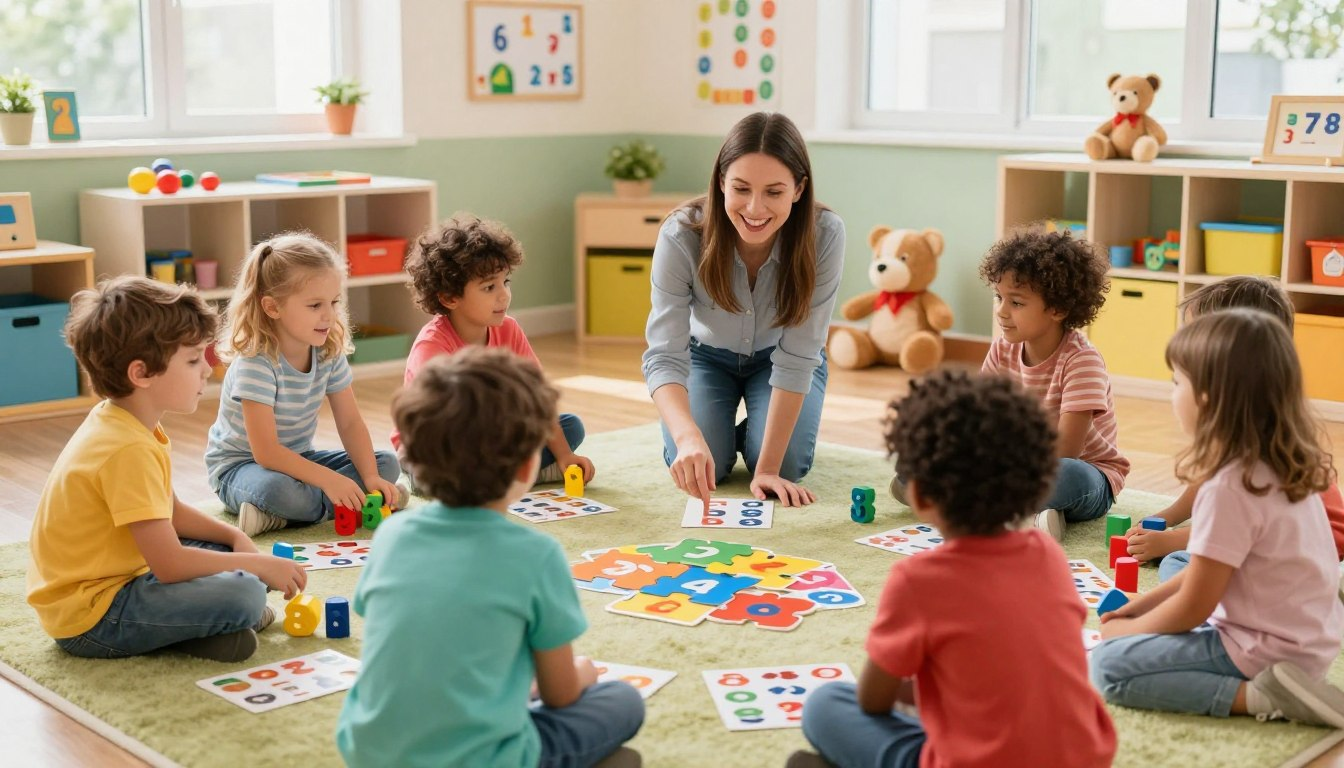
There is a persistent gap between how young children actually develop number sense and how most adults instinctively try to teach it. Worksheets, tracing sheets, and flash cards feel productive because they look like schoolwork. But for three, four, and five-year-olds, they are often the least effective tool available — and sometimes actively counterproductive.
The research on early numeracy is unambiguous on this point: preschool children learn number sense through play and continuous exploration in their natural environment, not through rote repetition of symbols on paper . A quality home learning environment shapes numeracy skills at preschool entry, while a quality preschool environment continues building them — and in both cases, the most effective approach is hands-on activity with real objects .
This article covers what the evidence shows about how young children actually learn to count, which play-based activities are most effective and why, and how to build a consistent routine around number learning that does not require a single worksheet.
Why Paper-Based Counting Practice Falls Short
The developmental explanation for why worksheets underperform with preschoolers comes down to how the young brain builds mathematical understanding. Before a child can make sense of the numeral “4” on a page, they need many experiences of counting four things — four blocks, four grapes, four steps — where the number corresponds to something tangible they can touch, arrange, and recount . The symbol is the final abstraction, not the starting point.
Research on preschool counting skills identifies several distinct competencies that must develop in sequence: rhythmic counting, stable order, one-to-one correspondence, cardinality (understanding that the last number counted represents the total), and the ability to count on from a given number rather than always starting from one . Worksheets can test whether a child has already acquired these skills, but they cannot develop them — because developing them requires physical interaction with objects .
Explicit memorisation activities like flash cards are not developmentally appropriate for preschoolers and should be avoided . The goal at this stage is building conceptual understanding through experience, not drilling symbol recognition.
What Research Says Actually Works
Subitising Games
Subitising — the ability to recognise a quantity instantly without counting — is one of the most trainable early number skills and one of the strongest predictors of later mathematical ability . A constructivist study with 63 preschool-aged children found that subitising games improved counting and subitising skills across children at varying ability levels . The mechanism is simple: when a child can look at a group of three objects and know immediately it is three, they free up cognitive resources for higher-level number operations .
Dice are one of the most accessible subitising tools available. Rolling a die and identifying the dot pattern without counting is exactly the kind of practice that builds this skill, and it integrates naturally into dozens of games a preschooler will already want to play .
Board Games and Number Path Games
A controlled study with kindergarten children found that playing a strategically designed number board game for four sessions of fifteen to twenty minutes produced significant improvements in counting, number identification, and more advanced arithmetic components like comparison and computation — compared to a control group who played a colour-matching game with identical social conditions . The children in the number game group were more engaged in later sessions than earlier ones, suggesting the games built rather than exhausted motivation .
The research attributes the effect to the combination of number path movement (physically moving a piece a counted number of spaces), competitive motivation, and immediate feedback within a structured social context . Simple games like Snakes and Ladders, Ludo, or even a handmade numbered path with a die produce this effect — the game structure matters more than the specific materials .
Counting Real Objects in Natural Contexts
University of Nevada Extension research identifies “counting anything and everything” as a core preschool numeracy strategy — counting food items, measuring quantities during cooking, and counting coins together . The critical element is that the objects are real and the context is meaningful. Counting five beans on a plate while preparing lunch is developmentally richer than circling five objects on a worksheet, because the bean is actually five-able: the child can touch each one, move them, and recount .
Finger counting deserves specific mention. Research confirms that using fingers for counting, comparison, and simple operations forms a basis for children to comprehend numbers up to ten, and that restricting this behaviour is counterproductive . Finger counting is not a crutch — it is a developmentally appropriate bridge between physical counting and mental arithmetic.
Movement-Based Counting: Why the Body Helps the Brain
Integrating movement with counting serves a purpose beyond simply keeping children engaged. Physical actions — jumping, clapping, stepping, crawling — create muscle memory that reinforces number sequences through a different cognitive channel than visual or auditory input alone . A child who has counted to five by doing five jumping jacks has encoded that sequence physically, not just heard it said.
Activities That Work at Home
- Stair counting. Counting steps aloud while climbing or descending is one of the simplest and most effective number sequence activities available. The rhythm of the movement naturally pairs with the rhythm of counting, and the child receives immediate physical confirmation that the sequence has an endpoint
- Jumping to a number. Call a number and have the child do that many jumps, hops, or claps. Begin with 1–5 for children just starting, progress to 1–10 as confidence builds, and add simple addition prompts (“you did five — now do two more”) for children ready for that step
- Number hopscotch. Draw a hopscotch grid with chalk and have the child hop squares in order while saying each number aloud. Variations include hopping only to a called number, hopping backwards for countdown practice, or hopping every other square for early skip-counting exposure
- Animal walk counting. Assign a number of bear crawls, frog jumps, or crab walks. The novelty of each movement style keeps engagement high across multiple rounds, and the physical commitment to each action reinforces the count
Music, Rhythm, and Number Songs
Songs and chants have been used to teach counting sequences in every culture that has documented early childhood education, and the research explains why they work: rhythmic repetition supports memory consolidation, and the emotional engagement of music increases both attention and retention . Songs like Five Little Ducks, One Two Buckle My Shoe, and The Ants Go Marching are not just pleasantly nostalgic — they encode the counting sequence in a format the preschool brain is specifically well-suited to absorb .
Clapping patterns and simple percussion add a further dimension. Clapping five times while saying “five,” then six times while saying “six,” builds the correspondence between the word, the symbol, and a physically produced quantity — the same three-way connection that research identifies as the foundation of genuine number sense . No instruments are required; hands, feet on the floor, and a wooden spoon on a pot are entirely sufficient.
Sensory Play: Learning Numbers Through Touch
Tactile engagement with number materials activates multiple sensory channels simultaneously, making the learning more durable and more accessible for children who find table-based activities difficult . The specific materials are less important than the principle: the child should be able to touch, move, and physically arrange number-related objects rather than observing symbols on a flat surface.
Activities That Use Everyday Household Materials
- Rice or sand tray number writing. Tracing the shape of a number in a sand or rice tray combines tactile input with number formation practice, and is considerably more engaging than tracing on paper for most preschoolers
- Playdough counting. Rolling a specific number of balls, pressing a specific number of dots into a flat piece, or forming the shape of a numeral all reinforce number concepts through physical creation. Making and counting playdough balls directly practises one-to-one correspondence — the understanding that each count corresponds to exactly one object
- Hidden object counting. Bury a known quantity of small objects in a bin of rice, dried pasta, or sand. The child finds them, lines them up, and counts the collection. Searching, finding, and physically lining up objects before counting builds the habit of organising a set before counting it — a foundational counting strategy
Building and Construction as Counting Practice
Construction play — blocks, LEGO Duplo, magnetic tiles — is counting practice in disguise. Building a tower of a specified number of blocks, counting bricks sorted by colour, or constructing shapes made from a set number of tiles all require one-to-one correspondence, cardinality, and number sequencing . Research on play-based mathematics consistently identifies manipulative play as one of the most effective formats for early numeracy development .
The most productive adult contribution during construction counting play is to ask, rather than tell: “How many blocks do you think you will need?” before a build, and “Let’s count and see if you were right” after it. This prediction-and-verification pattern builds the habit of thinking about quantities before acting, which is the cognitive foundation of estimation and early arithmetic .
| Material | Core Counting Skill | Extension Activity |
|---|---|---|
| Standard building blocks | One-to-one correspondence, cardinality | Add or remove blocks and recount for simple addition/subtraction |
| LEGO Duplo bricks | Pattern recognition, sequencing | Sort by colour and count each group; build number towers of increasing height |
| Magnetic tiles | Shape recognition, counting to build shapes | Challenge: build a specific shape using exactly a given number of tiles |
| Dice | Subitising, quantity recognition | Roll two dice and count the combined dots for early addition |
Everyday Contexts: Counting in the Kitchen and Beyond
One of the most consistent findings in early numeracy research is that the quality of everyday mathematical talk at home — the frequency with which parents use number words, ask counting questions, and draw attention to quantities in daily life — predicts numeracy outcomes at school entry independently of formal teaching . This means that the moments during which a preschooler develops number sense are not confined to designated activity time. They are distributed throughout the day.
- Snack and mealtimes. Count crackers onto a plate, count pieces of fruit before eating, count plates and cups while setting the table. One-to-one correspondence — each person gets one plate, one fork, one cup — is a mathematical concept as well as a table-setting instruction
- Cooking and measuring. Measuring cups and spoons turn mathematical relationships into physical experience: one cup is two half-cups is four quarter-cups. Counting scoops of flour or spoonfuls of sugar as they go into a bowl gives number sequence practice with immediate sensory reinforcement
- Shopping and sorting. Counting items into a bag, matching the number on a shopping list to collected items, and sorting objects into categories by type and counting each group are all opportunities that arise naturally in household routines
- Nature walks. Collecting a specific number of leaves, stones, or sticks, then counting the collection, combines physical activity with counting practice and gives children experience counting irregular, non-uniform objects — which is harder than counting identical blocks and builds more robust skills
Pretend Play: Making Numbers Meaningful Through Story
Role play scenarios that embed counting in narrative — a grocery store, a restaurant, a doctor’s office — teach children that numbers exist in the world for a reason: to represent quantities that matter . This is the conceptual bridge between counting as a rote recitation and counting as a tool, and it is one that abstract exercises cannot build.
Research on mathematics-friendly storybooks identifies a similar mechanism: books that use number words in context, ask children to count story elements, or embed simple number problems in narrative (counting the three pigs, the seven dwarfs, the five little ducks) expose children to mathematical language in emotionally engaging formats that support retention . Reading interactive counting books and pausing to ask questions — “how many are left now?”, “what do you think happens if one more joins?” — turns reading time into structured number sense practice .
Group Activities: Learning Numbers Socially
Play-based number learning has a social dimension that individual practice cannot replicate. Research on play-based mathematics in early childhood classrooms finds that the social context of games — the turn-taking, the shared problem-solving, the friendly competition — produces higher engagement and stronger learning outcomes than equivalent solo activities . Children in game-based number learning groups showed greater enthusiasm in later sessions than in earlier ones, suggesting that social game formats build rather than exhaust motivation over time .
Group counting chants, circle-time counting rituals, and team-based counting challenges all leverage this social motivation. For home settings, the same principle applies at a smaller scale: a parent counting alongside a child, making a wrong guess occasionally, and expressing genuine delight at a correct answer creates a social learning context more powerful than any solitary activity .
Building a Weekly Counting Routine
Consistency matters more than intensity. Short, frequent counting experiences distributed across the day and week produce stronger outcomes than occasional concentrated sessions . The goal is not to create dedicated maths time, but to make number awareness a habitual feature of ordinary activities.
| Time of Day | Natural Counting Opportunity | Target Skill |
|---|---|---|
| Morning routine | Count steps on the stairs, buttons on a shirt, spoonfuls of cereal | Number sequence, one-to-one correspondence |
| Mealtimes | Set the table counting items, count bites, sort and count food pieces | One-to-one correspondence, cardinality |
| Outdoor play | Hopscotch, nature collection, movement games | Number sequence, subitising |
| Bath time | Count toys, count pours of water, count fingers and toes | One-to-one correspondence, cardinality |
| Bedtime story | Count characters or objects in illustrations, ask “how many left?” | Cardinality, simple subtraction |
| Free play | Block towers, dice games, board games with number paths | Subitising, comparison, counting on |
FAQ
At what age should children be able to count to twenty reliably?
Most children develop reliable counting to ten by age four to five, and to twenty by age five to six, though there is significant individual variation . The more important milestone than the upper number is whether counting is accurate — whether the child applies one-to-one correspondence consistently and understands that the final number represents the total quantity .
Is it harmful to use worksheets at all?
Occasional use of number tracing or symbol recognition worksheets is not harmful. The problem arises when worksheets become the primary mode of number instruction, particularly before a child has the concrete experience with physical objects needed to make the symbols meaningful . Worksheets can consolidate skills already acquired through physical play; they are poorly suited to building those skills in the first place.
My child can recite numbers to twenty but makes mistakes when counting objects. Is this normal?
Yes, and it is an important distinction. Reciting a number sequence is a memorisation task; counting objects accurately requires applying one-to-one correspondence — touching or moving each object once while saying exactly one number word . These are separate skills. A child who can recite but not accurately count objects needs more practice with physical counting of real things, not more recitation .
How important is parent involvement in these activities?
Highly significant. Research consistently identifies the quality of home mathematical talk and adult interaction during number activities as a strong independent predictor of numeracy outcomes — separate from the activity itself . Sitting alongside a child, asking questions, and making number observations during ordinary routines produces measurable developmental benefit beyond what the child gains from solo play.
Can these activities replace a preschool maths curriculum?
For home settings, consistent play-based number activities of the kind described here cover the core number sense skills recommended for preschool-age children: number identification, counting and one-to-one correspondence, and early addition and subtraction with physical objects . They are not a replacement for a structured preschool environment — which provides consistent peer interaction, trained educators, and intentionally designed materials — but they represent the most effective thing a parent can do at home to support early numeracy development.
The shift from worksheet-based to play-based number learning does not require new materials, dedicated time slots, or special expertise. It requires noticing the counting opportunities that already exist in an ordinary day — and pausing long enough to count out loud together when they arrive. That consistency, accumulated across thousands of small moments, is what research shows actually builds a preschooler’s relationship with numbers.

Written by
Nouhaila Benis
Hey! I’m Nouhaila a children’s education teacher with over 5 years of classroom experience across multiple countries. She specialises in early literacy and phonics, with one clear goal: helping every child become a confident, independent reader one word at a time. As a full-time blogger, I share with you my best personal experiences.