
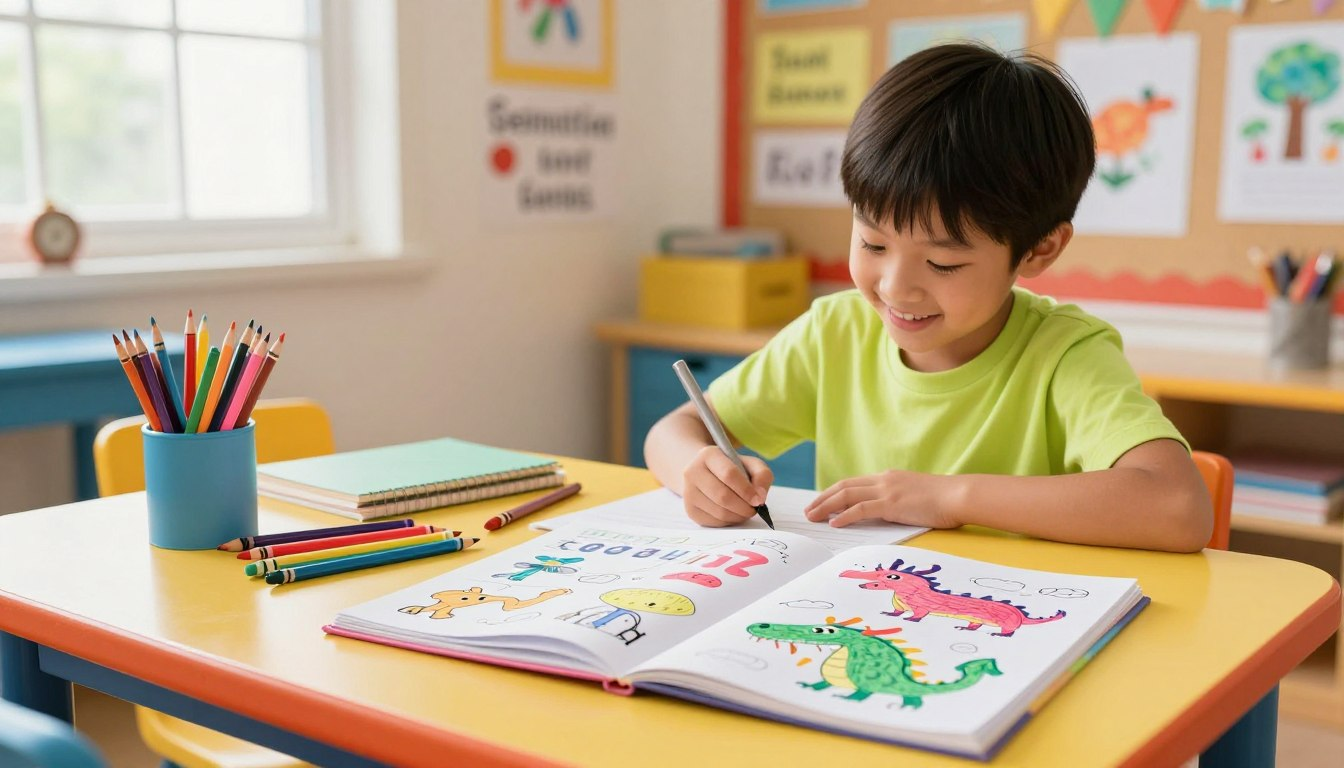
The blank page is one of the most common barriers young writers face — not because they have nothing to say, but because they do not know how to start. Writing prompts solve that problem directly. They remove the paralysis of an empty beginning and replace it with a clear first step, which is often all a six or seven-year-old needs to produce a full, enthusiastic story.
This guide covers everything parents and teachers need to use writing prompts effectively with early writers: how to set up a writing environment that reduces anxiety, which types of prompts work best at this age, how to use pictures and physical objects as story starters, how to connect prompts to curriculum subjects, and how to build a simple printable system you can reuse throughout the year.
Key Takeaways
- Writing prompts remove the blank-page barrier by giving children a clear, low-pressure starting point.
- The environment matters as much as the prompt — a calm, dedicated writing space reduces anxiety significantly.
- Open-ended sentence starters produce longer, more creative responses than closed or yes/no prompts.
- Picture prompts and physical objects are especially effective at this age because they give pre-writers and emerging writers something concrete to describe.
- Educational prompts that blend writing with science and history build subject knowledge and literacy simultaneously.
- Short, frequent writing sessions are more effective than occasional longer ones for building habit and confidence.
Why Creative Writing Matters for 6–7 Year Olds
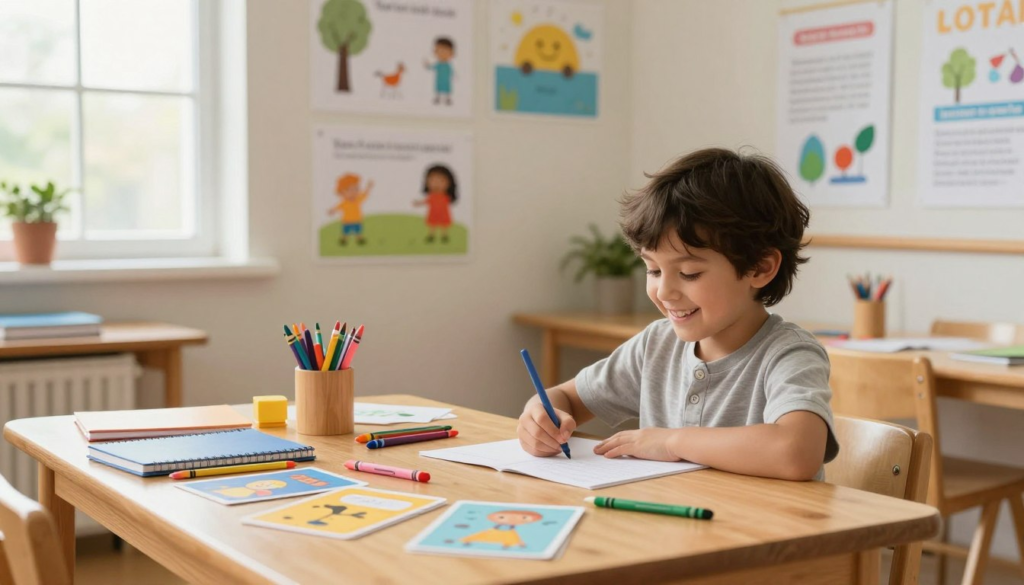
Ages six and seven sit at a specific and important transition in early literacy. Most children at this stage have moved past learning to decode words and are beginning to write independently. They have ideas — often vivid, unusual, and elaborate ones — but they frequently lack the technical control or confidence to get those ideas onto a page without support.
Creative writing at this age does more than produce stories. It builds vocabulary through use rather than memorisation, teaches sentence structure in a meaningful context, develops sequencing and logical thinking, and gives children a genuine reason to care about spelling and punctuation — because their story makes more sense when a reader can follow it. All of those literacy gains happen as a byproduct of a child trying to tell a story they care about.
Building Confidence Alongside Skill
Writing confidence at age six or seven is fragile and worth protecting carefully. Children who receive critical feedback too early, or who are corrected on every spelling error before their story is finished, often develop an avoidance relationship with writing that can persist for years. The most important thing a parent or teacher can do at this stage is respond to the content of what the child wrote — what happened, what they liked about the story, what surprised them — before ever addressing technical errors. When children feel that their ideas are interesting and worth hearing, they write more, and the technical skills improve naturally through practice.
How to Set Up a Writing Environment That Works
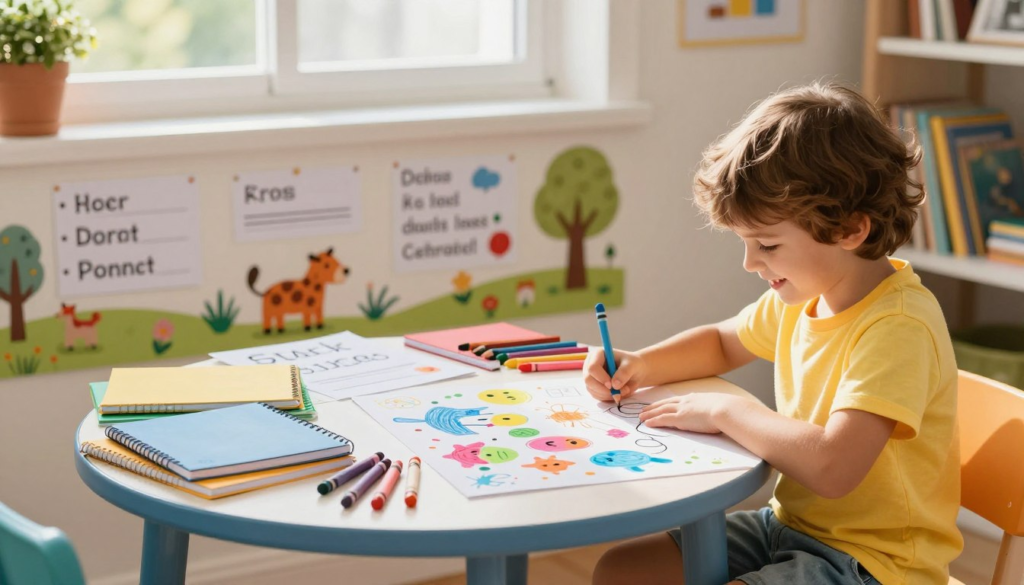
The physical environment shapes how a child approaches writing before they even pick up a pencil. A space associated with calm, choice, and creative freedom produces a different mental state than a space associated with homework and correction.
Creating a Dedicated Writing Space
The space does not need to be large or elaborate. A consistent spot — the same corner of a table, a particular chair near a window, a low shelf with a notebook and a cup of pencils — signals to a child that this is where stories happen. Consistency matters more than decoration. Children who write in the same spot at approximately the same time of day develop a writing habit faster than those who approach it randomly.
Keep the space clear of distractions and stocked with materials the child finds appealing: coloured pens, a stapler for making booklets, blank paper alongside lined paper, and a small collection of current prompt cards or pictures. Making the materials slightly special — a particular notebook reserved only for stories, for example — reinforces the idea that writing is a valued activity.
Balancing Structure and Freedom
The most common mistake with writing prompts is treating them as assignments with a correct answer. A prompt is a starting point, not a specification. If a child takes the prompt in an unexpected direction — if the prompt asks about a dragon in a library and the child writes instead about the librarian who befriended the dragon — that is creative success, not deviation from the task. The moment children understand that the prompt is a suggestion rather than a rule, their writing becomes significantly more adventurous and sustained.
Picture Prompts: The Most Effective Tool for Visual Learners
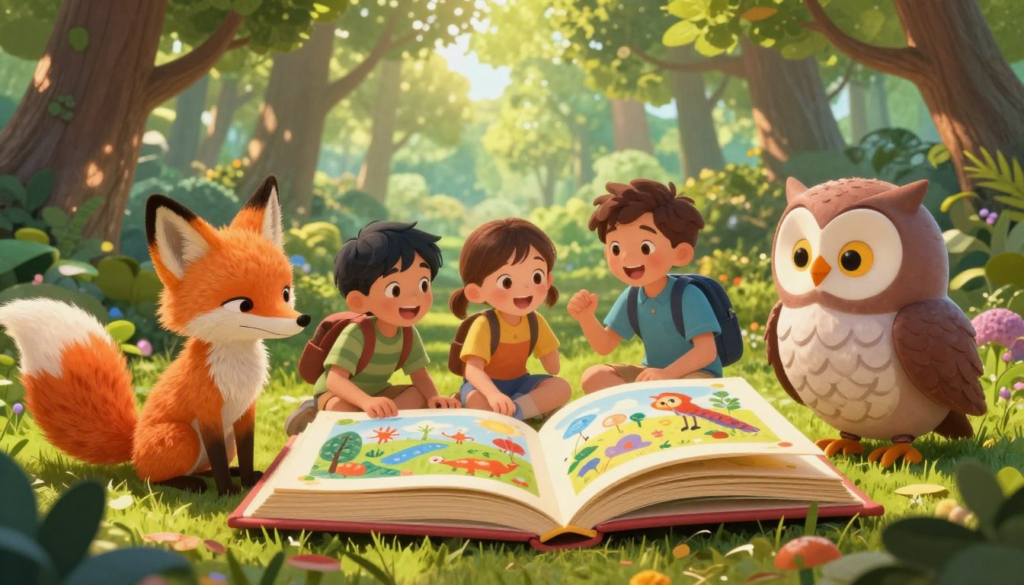
Picture prompts work exceptionally well with six and seven-year-olds because they bypass the language-retrieval problem entirely. A child who struggles to think of “what to write about” can almost always describe what they see — and describing what they see is the beginning of storytelling.
What Makes a Good Picture Prompt
The most effective picture prompts for this age group share a few qualities: they contain a character (human, animal, or creature) with a visible emotion or action; they show an interesting setting with details to describe; and they suggest a story in progress rather than a static portrait. A picture of a child standing outside a mysterious door is more generative than a picture of a child standing in a field, because the door implies a question: what is behind it?
Images of fantasy settings — dragons, mermaids, talking animals, enchanted forests — are particularly effective because they remove the constraint of realism and give children permission to imagine freely. When the world in the picture is not bound by real-world rules, the child’s story does not need to be either.
How to Use Pictures as Story Starters
Before asking a child to write from a picture, spend two minutes talking about it together. Ask questions that build the narrative foundation:
- “Who is this character? What is their name?”
- “What do you think happened just before this picture was taken?”
- “How does the character feel right now? How can you tell?”
- “What do you think will happen next?”
By the time a child has answered these questions verbally, they already have a beginning, middle, and end in their head. The writing task becomes transcription of something they have already imagined rather than invention from nothing — which is far less intimidating.
Using Action Images for Story Structure
Pictures that show movement or conflict are especially useful for teaching narrative structure. When a child sees a character in the middle of a chase, a fall, or a discovery, they naturally want to explain what came before and predict what happens next. That instinct is exactly the sequence-beginning-middle-end structure that early writing instruction tries to build. Action images make the structure intuitive rather than taught.
Sentence Starters That Unlock Stories
Sentence starters address writer’s block directly by providing the hardest part of any piece of writing: the first few words. Once a child has a beginning that feels right, momentum usually follows. The key is choosing starters that are open enough to allow genuine choice but specific enough to eliminate the blankness that causes freezing.
Effective Sentence Starters by Type
Personal narrative starters — these invite the child to draw on their own experience, which reduces the cognitive load of invention:
- “The best day I can remember was when…”
- “I was really scared the time that…”
- “Something nobody knows about me is…”
Adventure and fantasy starters — these open the door to imaginative fiction and are usually the most popular with this age group:
- “Suddenly, the door creaked open and…”
- “The map showed a path no one had ever taken before…”
- “The dragon had been waiting at the top of the tower for one hundred years, and finally…”
Descriptive starters — these push children toward sensory language and scene-setting:
- “The first thing I noticed was the smell of…”
- “Everything was quiet except for…”
- “It was the strangest place I had ever seen because…”
Encouraging Descriptive Language After the Opening
Once a child has a sentence or two down, gentle prompting questions can extend the writing without interrupting the flow. Ask: “What did it look like?” “What happened next?” “How did the character feel about that?” These questions model the kind of detail that makes stories come alive, and most children respond to them with enthusiasm once the initial reluctance is overcome.
Educational Writing Prompts That Build Subject Knowledge
Writing prompts can do double duty when they are connected to what a child is already learning. A prompt that asks a child to write about a caterpillar’s journey reinforces the same concepts as a science lesson on life cycles — but in a form that requires the child to understand and reconstruct the information rather than passively receive it. That reconstruction is a powerful learning tool.
Science-Themed Prompts
- “Write a diary entry from the point of view of a seed that just got planted in the ground.”
- “You are a raindrop falling from a cloud. Where do you go? What do you see?”
- “Invent a planet and describe what the weather, animals, and plants are like there.”
- “A butterfly is telling the story of its life. Write it from the beginning.”
History-Themed Prompts
- “Imagine you woke up and it was 100 years ago. What is different about your morning?”
- “You have just met a famous inventor. What do they show you? What do you ask them?”
- “Write a letter from a child living in a pioneer home to a friend in the future.”
| Subject | Prompt Idea | Learning Goal |
|---|---|---|
| Science | Diary of a seed | Understanding plant life cycles |
| Science | A day as a raindrop | The water cycle |
| Science | Inventing a new planet | Space concepts and creative thinking |
| History | Waking up 100 years ago | Comparing past and present daily life |
| History | Letter from a pioneer child | Historical empathy and perspective |
| History | Meeting a famous inventor | Learning about historical figures |
Interactive Writing Activities That Make Writing Social
Some children write more willingly when the activity is collaborative. Writing does not have to be a solitary task, particularly at age six or seven when social interaction is one of the primary ways children learn and engage.
Collaborative Storytelling
Take turns adding sentences to a shared story — one sentence each, alternating. The unpredictability of what the other person adds is genuinely exciting for most children, and the social pressure of a waiting partner is a powerful motivation to contribute. This activity also teaches children to listen and build on what came before, which develops one of the most important revision skills in writing: the ability to read back what has already been said and continue in the same voice.
Using Physical Objects as Story Starters
Give a child an ordinary object — a key, an old photograph, a smooth stone, a small toy — and ask them to write a story about where it came from, who owned it, and what happened to it. Physical objects engage a different kind of imagination than written or picture prompts. When a child can hold the object, turn it over, and feel its weight, their descriptions become more specific and sensory. The object also serves as a reference point throughout the writing session — the child can look at it again when they get stuck.
| Feature | Solo Writing | Interactive Writing |
|---|---|---|
| Social interaction | Low | High |
| Best learning style | Visual, independent | Kinesthetic, social |
| Primary benefit | Focus, independent voice | Creativity, dialogue, listening |
| Engagement level | Moderate | Very high |
| Best use case | Journal writing, quiet time | Paired or family storytelling, classroom activities |
Prompts That Build Emotional Intelligence
Writing prompts that ask children to take the perspective of another character are one of the most effective tools for developing empathy. When a child writes from inside a character’s experience — particularly a character who is nervous, lonely, or facing an unfair situation — they practise the mental skill of perspective-taking in a low-stakes, imaginative context.
Empathy-Building Prompts
| Scenario | Emotional Focus | Discussion Question |
|---|---|---|
| A friend loses their favourite toy | Sadness, disappointment | “What could you say or do to help them feel better?” |
| A new student arrives at school knowing nobody | Nervousness, loneliness | “How did it feel the first day? What made it better?” |
| Two friends both want the same thing and there is only one | Frustration, fairness | “How do they work it out? Is there a solution everyone feels good about?” |
| A character does something kind that nobody sees | Generosity, quiet pride | “Why does the character do it even if nobody notices?” |
Problem-Solving Through Story
Giving a character a genuine problem to solve — not a dangerous adventure, but a realistic dilemma — produces some of the most thoughtful writing from children this age. Ask your child to write about a character who needs to apologise to a friend but does not know how, or a character who finds something that does not belong to them. These prompts develop reasoning alongside writing because the child must think through the situation logically in order to resolve it on the page.
Imaginative Prompts to Stretch Creative Thinking
The most generative prompts for children who are already comfortable with basic writing are those that require genuine invention — creating something that does not exist, reimagining something familiar, or taking an ordinary situation into an extraordinary direction.
World-Building Prompts
- “Invent a world where everything is the opposite of here. What are the rules? What is hard? What is easy?”
- “Design a school for magical creatures. What subjects do they study? Who is the teacher?”
- “Create an island that no one has ever visited before. Describe what you discover when you land.”
Everyday Objects as Heroes
Ask your child to choose any object in the room and make it the main character of a short story. The lamp wants to see the world outside the window. The mug has been listening to every conversation in the kitchen for years and finally decides to speak. The stapler is tired of being the least interesting thing on the desk. This type of prompt teaches children to find stories in unexpected places — a habit of mind that sustains creative writing long after the prompts themselves are no longer needed.
Building a Simple Printable Prompt System
A printable prompt system does not need to be elaborate to be useful. Its main purpose is to reduce the time between “let’s do some writing” and actually writing — eliminating the moment where a child has to wait while a grown-up thinks of something. A small, organised collection of ready-to-use prompts means writing can start in under two minutes on any given day.
Designing Effective Prompt Sheets
The best prompt sheets for six and seven-year-olds share a few design features:
- A clear, readable sentence starter at the top with enough white space below to write comfortably
- A small image or visual cue that reinforces the prompt theme
- Two or three guided questions below the main prompt for children who want more scaffolding (“Who is in your story?” “Where are they?” “What happens?”)
- A space for drawing alongside the writing, which is important for children who process ideas visually
Organising Prompts for Year-Round Use
Sort your printable prompts into a small filing system by category: fantasy and adventure, everyday life, science and nature, feelings and characters, and seasonal themes. Within each category, have a handful of prompts at different difficulty levels — some requiring only two or three sentences, others with space for a longer story or a full page of writing. Rotating categories week by week keeps the activity feeling fresh, and having prompts at different difficulty levels within each category lets you match the task to how the child is feeling on a given day — ambitious, tired, inspired, or resistant.
FAQ
How long should a writing session be for a 6–7 year old?
Ten to fifteen minutes of focused writing is usually sufficient for children this age. Ending while the child is still engaged — before frustration sets in — is more important than completing a specific amount of writing. Consistency matters more than length: short daily sessions produce better results than occasional long ones.
Should I correct spelling and grammar during creative writing?
Not during the writing itself. Correcting errors mid-session interrupts the flow of ideas and teaches children that the most important thing about writing is technical accuracy — which makes them more cautious, not more skilled. Address technical errors separately, in a brief and specific way, after the writing session is finished and you have already responded warmly to the content of the story.
What if my child refuses to write?
Change the format rather than the expectation. A child who resists writing on lined paper might write willingly in a blank-page notebook, on a whiteboard, in a homemade booklet, or dictating while a parent transcribes. The writing skill is still developing as long as the child is composing sentences and expressing ideas — the physical act of handwriting is separate from the composition skill and should not become the barrier.
What are the best prompts for children who say they have no ideas?
Use a physical object or a picture prompt rather than a written sentence starter. Children who struggle to generate ideas from words alone often respond immediately when given something visual or tactile to describe. “Tell me about this picture” or “Write a story about this key” provides a concrete anchor that reduces the cognitive demand of invention.
How do I make writing prompts educational without making them feel like schoolwork?
Embed the educational content in the premise rather than stating it explicitly. “Write about a caterpillar’s journey” teaches the life cycle without mentioning it as a learning goal. “What would a pioneer child’s breakfast look like?” teaches historical comparison through imaginative play. When the learning is inside the story rather than announced before it, children engage with the content as writers rather than as students.
Can I use Google Slides or digital tools to create printable prompts?
Yes. Google Slides, Canva, and Microsoft Word all work well for creating simple prompt sheets. Use a large, readable font, add a relevant image in the corner, and leave generous line spacing below the prompt. Print on slightly heavier paper if possible — it makes the sheets feel more substantial and they hold up better when children write on them with pencil or crayon.

Written by
Nouhaila Benis
Hey! I’m Nouhaila a children’s education teacher with over 5 years of classroom experience across multiple countries. She specialises in early literacy and phonics, with one clear goal: helping every child become a confident, independent reader one word at a time. As a full-time blogger, I share with you my best personal experiences.